When I Left the Orphanage, They Said I Inherited Just an Overgrown Cave—Until I Cleared the Vince
When I Left the Orphanage, They Said I Inherited Just an Overgrown Cave—Until I Cleared the Vince
.
.
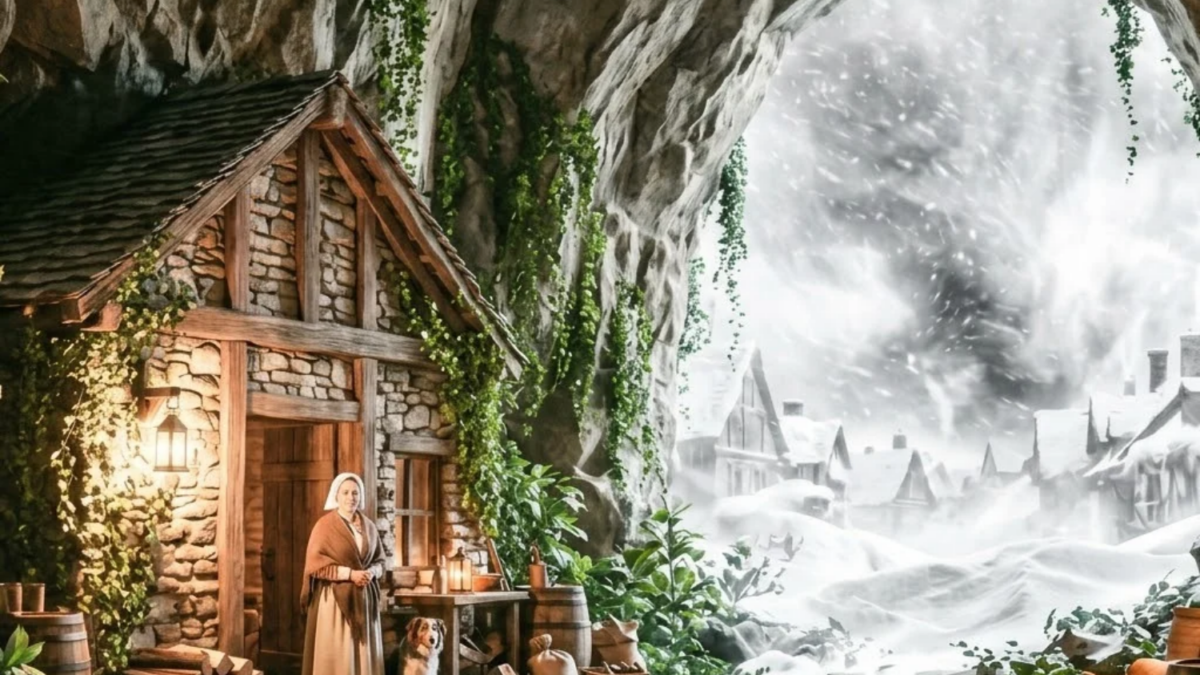
The wall came down from the western ridge like something a rifle had fired. Fifty miles of open Dakota prairie vanished inside a single breath of white. Somewhere under that advancing wall, a lantern was already lit in a kitchen window, small and steady, waiting. A woman’s hand at that window, wind-chapped, steady. She did not look at the storm the way the others in the valley were looking at it.
She had felt it an hour ago. Beside her, on the wall, a glass tube of mercury began quietly to crack. Behind her, a child asked a question no one answered. Outside, thirty chimneys along the creek were still smoking. By morning, there would be one. In the yard behind the cabin, a low mound of packed earth waited under the drifts—a door the men of the valley had laughed at all summer.
The wind hit the door. The door held.
The night the cold came to Whitethorn Creek did not announce itself the way winters usually did in Dakota territory. There was no gray building of clouds across three days, no slow drop of the mercury that gave a woman time to salt the pork and stack the kindling higher against the north wall. It came the way a rifle hammer falls on a live cap, sudden and final, sweeping down out of the bad river draws with a sound like sheet iron being torn in half. It came in the last hour of daylight on a Tuesday in early December of 1886. And by the time the wives along the creek had turned to look at the western sky, the horizon was already gone, swallowed inside a wall of white that moved faster than a running horse.
Inside a small cabin set back against a rise of frozen prairie, a woman named Otie Brenamman was already moving. She had felt the pressure change an hour before anyone else in the valley felt it, the way her father had taught her to feel it when she was still a girl in Lehigh Valley, Pennsylvania. And the two of them would stand at the mouth of the anthracite shafts before dawn, watching the cold dust hang or fall. Air that would not settle meant weather coming. Air that pressed against the eardrums meant weather already here. Tonight, the air pressed.
She had two children, and she was thirty-five years old, and she had buried her husband in the previous spring before the ground was even soft enough to take him properly. The men of the valley had helped her dig because that much charity they were willing to extend, but they had not spoken to her about the shape of the grave, or about what the winter had done, or about the wet cough that had opened her husband’s chest for three long nights before the last one. They had put Wendell Brenamman in the ground and gone home to their own suppers, and none of them had ever come back to ask her how she was making it through. That suited her. She had never been the kind of woman who wanted the comfort of a neighbor’s hand on her shoulder.
What she wanted was the kind of thing no man in the valley had thought to offer, which was for someone to sit with her at her kitchen table and look her in the eye and admit that Wendell had died because the cabin had been built wrong.
That admission had never come. Instead, there had been laughter, first quiet and then loud. And by the end of the summer, the laughter had become the standing joke of the whole creek—the story a man told his wife over dinner when he wanted to feel taller than he was: Otie, the widow who dug in the dirt.
By the spring of 1886, a full year after burying Wendell, she had begun to read her father’s notebook again in earnest, cover to cover at night by the kerosene lamp, the German words swimming up out of her childhood one at a time. That June, she had begun the pit alone with a spade she had bought used at Halloway’s mercantile for a price the man behind the counter had smirked at as he took her coin. Every morning she had walked out to the slope behind the cabin with her son Anel, who was eight and quiet, and her daughter Margarite, who was six and not quiet at all, and the three of them had worked at the ground until the sun climbed high enough to sting. By July, the hole was chest deep. By August, it was over her head. By September, she was hauling scavenged plank from a burned-out claim two miles up the draw, packing clay against the walls, her palms mixing the clay with cut straw and rendered tallow, the way her father had once shown her in a cold-dust notebook that she still kept wrapped in oilcloth beside her bed.
The men of the valley had ridden past her work all summer. Some had touched their hats, some had not. Ephraim Halloway, who owned the mercantile and half the standing timber for six miles, had reined up one August afternoon and sat his horse for a long minute in the sun before speaking. His voice had carried the particular slowness of a man who wanted the words to land.
“A hole in the ground is not a home for Christian children,” he had said. “A woman who could not tell the difference between a house and a grave is a woman who has lost her bearings after her husband’s passing.”
He had said all of this in the tone a man uses when he means to be helpful. And then he had ridden on, and by the evening every wife along the creek had heard some version of it. None of them had come to see the pit. That was the part that had cut her—not the laughing, but the not looking.

Chapter 2: The Mercury and the Mercury Glass
Now, standing at her kitchen window with the light dying fast behind the western ridge, Otie Brenamman watched the wall of white come down out of the draws, and she was already reaching for the coats. Anel had come in from the woodpile without being told. He was a boy who had learned to read his mother’s shoulders the way other boys read the sky, and his shoulders now were saying what hers were saying, which was that this was not an ordinary storm. Margarite was still at the table with a slate and a piece of chalk, drawing a horse that had too many legs; she looked up when her mother crossed the room and did not ask any questions, which was itself an answer. The child had lived through her father’s dying. She knew when to stop drawing.
The mercury barometer on the wall beside the stove had been her father’s. Otto Brenamman had brought it across from the old country in 1849, wrapped inside three shirts and a Bible, and he had hung it in every kitchen he ever lived in until the day a mine collapse in the Panther Creek shaft had ended his hanging of anything. The glass tube had come to Otie the year she turned nineteen, and she had carried it through two moves in a marriage and a widowing, and it had never once cracked.
Tonight, as she reached past it to lift her daughter’s coat off the peg, the glass gave a small, hard sound like a walnut splitting under a boot heel, and a bead of mercury slid down the inside of the tube and pulled at the bottom in a way it had never pulled before.
She did not stop moving. She had felt the pressure. The glass was only confirming what her lungs had already told her.
There is a moment in every disaster when the person at the center of it stops being a person and becomes a set of hands. Otie’s hands buttoned her son into his father’s old wool coat, cut down and restitched twice. Her hands wrapped a scarf twice around her daughter’s mouth. Her hands took the lantern down from the hook and shook it to hear the kerosene move, took the tin of matches off the mantel, took the wool blanket off the bed, folded it once, and laid it over her own shoulders like a shawl. Her hands did all of this while her mouth said nothing, because the children did not need words yet. The words would come later when there was time for them, and if there was not time for them, then the words would not have mattered anyway.
The wind hit the cabin as she opened the door. It hit like a shoulder. The door tried to slam back into her, and she braced her boot against the jamb and forced the children through ahead of her.
The cold that met them on the other side was not cold the way a Pennsylvania winter was cold. It was a cold that had teeth in it, a cold that reached past wool and past linen and past skin, and closed its fingers around the bones underneath. Margarite made a small sound that was not quite a cry, and Anel took his sister’s mitten hand without being told, and the three of them staggered out into the yard while the sky above them turned from white to something closer to the color of old iron.
The pit was thirty yards from the back door. In summer, that had felt like nothing. Tonight, it felt like a mile. The wind was already piling the snow against the low door of the cellar, driving it in long, curling drifts that reached above Margarite’s knees before they were halfway across, and Otie had to bend and lift her daughter by the coat and half-carry her the rest of the way. Anel followed on his own, breath tearing in and out of him in short white plumes that the wind ripped away almost before they had left his mouth. He did not complain. He had not complained since his father died.
She had feared the latch all summer. She had oiled it twice in September and again in November, and still she feared it, because a latch that froze meant a door that would not open, and a door that would not open meant that everything she had built for the last six months was decoration.
She reached the door and slammed her shoulder against it before she even tried the handle. The door groaned and did not give. She slammed it a second time, and it opened with a sound like a bone coming out of a socket.
The three of them tumbled down the short earthen ramp, and she pulled the door closed behind them, and the wind stopped. That was the first thing: the wind stopped. Not the sound of it, because the sound came down through the vent shaft in a thin, high moan that would go on for the next three days without ever pausing, but the feel of it, the shove of it against the ribs. Down here, the air was still. Down here, the air had weight.
Chapter 3: The Sanctuary of Clay
She stood at the bottom of the ramp with her hand on the door for a full second before she remembered to move, and she moved because Margarite was crying now, quietly, the way she had cried on the last night of her father’s life.
Otie lit the lantern. The light climbed up the packed clay walls the way it had climbed a hundred times in her imagination during the long nights when she had lain awake calculating slope, vent angle, and clay thickness. The walls looked exactly the way she had imagined them, which was the strangest and most steadying feeling of her life. She had built this. She had built it with hands that had bled and calluses that had split and reformed and split again. And she had built it against the laughing of every man in the valley. Now the light of a single kerosene lantern was showing her that it was real. It was here. It held.
Anel was already at the back platform. He knew where the quilts were because he had helped stack them there in October. He climbed up and pulled his sister up after him, and Margarite crawled into the pile of wool and old blankets and pressed her face against the padded coat that had belonged to Wendell. For a moment, Otie had to look away because her daughter did not remember her father the way Anel did, but her daughter remembered the smell of him, and the smell was still in the coat, and there was a mercy in that which Otie was not prepared to feel just now.
She turned to the stove. The stove was the piece of the pit that Ephraim Halloway had laughed at hardest. A stove underground, he had said one evening at the mercantile in a voice loud enough to carry to the woman standing at the far counter with her flour and her salt, is how a woman kills her children twice—once with smoke and once with fire. And if she wanted to know how a proper man kept his family warm, she was welcome to walk through his own front door any evening and see for herself.
He had laughed after he said it. The men beside him had laughed. Otie had paid for her flour and her salt without looking at any of them, and she had walked home along the creek with the paper sack against her hip. That night she had sat at her kitchen table until the candle burned down to nothing, and she had drawn on a scrap of butcher paper the exact curve of the chimney flue she would build, because a proper man had never in his life stood in a working coal shaft and watched the firedamp move. Her father had. Otto Brenamman had spent thirty-one years underground before the shaft took him, and Otto Brenamman had taught his only daughter that the difference between a stove that killed you and a stove that saved you was not the stove. It was the chimney, and the chimney’s neighbor, and the second small shaft nobody thought to build.
She had built the chimney with an S-curve to break the wind’s push. She had built the vent shaft separately ten feet away with its mouth angled downslope so the prevailing westerlies could not drive straight into it. And she had built a third opening—small enough that a grown man would miss it—in the eastern wall of the cellar, sealed now with a stopper of oiled leather kept in reserve for a night she hoped would never come.
The tinder caught on the second match. She fed it small strips of pine shaving, then a length of split cedar, then a proper piece of oak. The stove began to draw. She watched the flame lean into the flue and waited for the draw to hold, and it held. Only then did she let her shoulders drop half an inch, because a stove that drew on the first night was a stove that would draw on the fourth night, and the fourth night was the one she was already counting toward.
“Ma?” Anel’s voice was small, coming from the platform. “Is it going to get colder?”
Otie did not lie to her children. She had made that decision on the night Wendell died, when Anel had asked her whether his father would be at breakfast, and she had told him no, and the boy had nodded once and gone back to sleep. She had known then that lying would cost her more than the truth ever would.
“Yes, but not in here. Not the way it is out there.”
Margarite’s small voice came from inside the quilts: “Is Papa cold?”
Something inside Otie’s chest folded in on itself. “Papa is past being cold, my heart.”
The child accepted that. The child at six understood past being cold better than most grown men in the valley understood their own bank ledgers.
Otie set the lantern on its iron hook and turned the flame down to save the kerosene, and the pit settled around them in a warm, dim gold that made the packed clay walls look less like a hole in the ground and more like the inside of a bread oven, which was what she had wanted from the first spadeful in June.
Chapter 4: The Sound at the Door
She sat down on the floor with her back to the door, and she let herself for one minute only remember her husband. Wendell had been a good man. He had not been a strong man, and he had not been a wise man, but he had been a good one, and there was a difference. He had listened when other men talked, and he had believed what other men told him. And when Ephraim Halloway had stood in the doorway of their half-built cabin in the spring of 1884, looking at the stack of squared timbers Wendell had ordered, and said gently that a man could save half his lumber cost by framing the north wall in single-thickness plank because the wind on Whitethorn Creek never really came from the north anyway—Wendell had believed him.
He had believed him because Ephraim Halloway owned the mercantile and had lived in the valley for eleven years and spoke with the calm of a man who had seen weather, and Wendell had been young and new to the territory and grateful for a neighbor’s counsel. He had returned half the lumber the following week.
Otie had not been present for that conversation. She had been in Fort Pierre with her mother-in-law, laying the woman in the ground. When she came back, the cabin was framed and the north wall was already up, and she had stood in the yard with her carpetbag still in her hand, looked at the thinness of the planks, and known in the exact way her father had once known a shaft was going to fall, that this wall was going to kill someone.
She had not said it. That was the thing she could not forgive herself for. She had not said it because Wendell had been proud of the work, and because Ephraim Halloway had ridden up on his gray gelding that same afternoon to admire it, and because a wife who contradicted her husband in front of a neighbor was a wife who did not know her place. She had held her tongue for two years through two mild winters, and she had almost let herself believe that maybe the wall would hold.
And then the winter of 1885 had come, and the wind had come—not like tonight’s wind, only a normal Dakota wind—and by the third week of January, Wendell had been coughing blood into a handkerchief that she washed every morning and hung on a nail beside the stove where it never quite dried. He had died apologizing.
That was the part she carried. He had held her hand on the last night, and he had whispered over and over that he was sorry the cabin was cold, that he should have kept the lumber, that he did not know why he had listened. She had told him it was not his fault. She had told him it was not his fault a dozen times before his eyes closed. It had not been a lie. It had not been the whole truth either.
The stove ticked. Anel’s breathing on the platform had gone even. Margarite had already slid into sleep, one small hand knotted in the wool of her brother’s coat.
Otie sat with her back against the door, and she let herself feel for the first time in six months the possibility that she had built the thing correctly.
Then the first knock came.
It came against the door behind her shoulder blades, so close that she felt it before she heard it—a dull, weighted thump that traveled up her spine and set her teeth on edge. She was on her feet before the second knock. The children did not stir.
The knock came again, harder, and with it a voice that the wind was trying to eat, a voice that had to shout the second syllable of her name to get past the moan of the vent shaft: “Brenamman! Brenamman, open the door!”
She knew the voice. She had known the voice since the first summer she had come to the valley. Ephraim Halloway was on the other side of her cellar door, and he was shouting her name into a blizzard, and there was no scenario in which that was a thing that was happening for a small reason.
She did not open it, not yet. She pressed her ear to the wood and she said, loud enough to carry through: “What is it?”
“My boy! My boy, Brenamman—wit—he’s not right. The stove went out. The whole east wall’s down. Please, for God’s sake, open the door!”
There was a sound under his shouting that took her a moment to identify. It was the sound of a grown man trying not to weep and failing. She had heard that sound exactly once before in her life, from her own throat on the night her husband died. She recognized it the way a person recognizes their own handwriting.
“You have your son with you?”
“In my arms! He’s—Brenamman, he’s blue around the mouth. Please!”
She stood there with her palm flat against the door, and she felt the whole of her life gather itself into a single choice. She could open the door and let in the man who had told her husband to save on lumber. She could open the door and let in the man whose laughter had followed her out of the mercantile every week for six months. She could open the door and share the heat she had built for her own two children with the child of a man who had, in the most literal sense, arranged the death of her husband.
Or she could keep it closed.
She thought about it for less than three seconds. She had already known in the summer that this was the choice she was building toward: a pit that saved only its builder was a hole; a pit that saved a neighbor was a shelter. She had not dug for six months in order to end up sitting inside a hole.
She opened the door.
Chapter 5: The Ledger of the Pit
The wind came in first, ahead of Ephraim, ahead of the boy, ahead of anything a person could see. It came in as a solid thing, a wall of white that rolled down the ramp and hit the far side of the pit and broke around the stove, and for one long second Otie thought the stove would go out.
It did not. She had built the S-curve for exactly this. The flame guttered and steadied, and then Ephraim Halloway was stumbling down the ramp with his son held against his chest like a sack of grain. Behind him, a leather pouch dropped from his coat pocket and hit the packed earth with the sound coins make when they are heavy.
She looked at the pouch. She looked at him. He had followed her eyes down. His mouth opened, and something came out of it that was not quite language, and she understood with a clarity that made her tired in a way she had not been tired since spring: he had brought silver. He had brought silver to buy a place for his son inside her cellar.
She bent down and picked up the pouch, and she did not weigh it in her palm, and she walked past him to the door, which was still cracked open against the wind, and she flung the pouch up the ramp and out into the storm. It made no sound landing. The snow ate it. She would find it in April, or she would not. It did not matter.
“I do not sell space in my home,” her voice was not raised; it did not need to be. “I do not sell it to you, and I would not sell it to any man. Your boy is a child. Bring him to the platform.”
Ephraim Halloway stood in the middle of her cellar with snow melting on his beard, and he looked at her the way a man looks at a country he has never been allowed to enter. He nodded once. He carried Whit past her to the platform where Anel and Margarite were beginning to stir, and he laid the boy down on the quilts.
Otie went to the stove and opened the damper a quarter turn, because there were now four bodies in the pit instead of three, and the air would need to move differently.
Whit was ten years old. He had been a bright child once, a running-through-the-grass child, and now his lips were the color of skim milk, and his fingertips were glassy, the way a person’s fingertips only ever went once. Otie put her ear to his chest. She heard a heartbeat, but the heartbeat was slow, slower than a boy’s heartbeat had any business being. She straightened up and began to speak the way her father had spoken when the shaft was in trouble—quietly and without wasted words:
“Do not rub his hands. Do not put him near the stove. Do not give him whiskey if you have any. Take off his outer coat, but not his shirt. Bring me the smallest of the flat stones from the shelf.”
She did not look at Ephraim while she said any of this. She did not need to; he did what she told him. While he was doing it, she set a riverstone the size of her fist on top of the stove and counted to two hundred. Then she wrapped the stone in a strip of wool and pressed it against Whit Halloway’s small chest at the center of him, where a person’s warmth was meant to come from and go back to.
Ephraim watched. He watched with the face of a man watching a woman do something he had spent six months telling his neighbors was foolishness. He did not speak. Otie did not speak either.
After a long minute, Whit made a small sound in the back of his throat. It was not a word; it was the sound a person makes when the machinery of them remembers that it is supposed to be running.
Ephraim Halloway sat down on the floor beside the platform, and he put his face in his hands, and his shoulders began to shake without any noise at all. Otie left him to it. She had no comfort to offer him, and she was not going to invent any. She went back to the stove and added one more small piece of oak, because the pit now had to warm four bodies through a night whose bottom she could not see.
Chapter 6: Confession in the Clay
The night lengthened. The wind above them climbed and held and climbed again, and the moan through the vent shaft became something that a person eventually stopped hearing because a person cannot listen to the same note for that long without going somewhere else inside themselves.
Margarite slept. Anel slept. Whit Halloway on the platform took one whole breath after another without stopping, which was itself a small victory.
Around the third hour, Ephraim Halloway spoke. He spoke quietly, low enough that only Otie would hear him over the moan of the vent, and he spoke without turning his head because a man confessing does not want to see the face of the woman he is confessing to. His voice was flat, the way a river’s voice goes flat when the current has run under ice for a long time.
“The lumber in the spring of ’84—when Wendell ordered the timber for your walls… I told him I told him he could send half of it back.”
Otie did not move. She had known this for two years in the way a wife knows a thing without having been told, but she had never heard a man in the valley say it aloud, and hearing it now was different from knowing it. Hearing it had a shape she had not been prepared for.
“I had a buyer for the good stock up at the Witham claim. He would pay near double what your husband was paying, and I could not sell it twice,” Ephraim’s hands were on his knees; his knuckles had gone the color of old ivory. “I told Wendell the wind on Whitethorn Creek did not come from the north. I told him. I knew it was not true. I have lived in this valley eleven winters. The wind comes from every direction on this creek, and a Christian man knows it.”
The lantern hissed. Somewhere on the platform, Whit Halloway’s breathing hitched once, then steadied.
Ephraim did not lift his eyes. “He died because of me. Your husband died because I wanted the two hundred dollars from Witham’s timber. My son said what he said tonight because he heard me say it to his mother. He heard me say a widow with no name in the valley would die before spring and no one would remember to ask why.”
Otie sat with her back against the door, and she felt something inside her chest do a slow, terrible thing. It was not anger, exactly; anger would have been simpler. It was the opening of a drawer she had kept locked for a year and a half. She had known. She had known and she had told no one. She had suspected the shape of it, and now the shape was a man in her cellar kneeling in the dirt, weeping without noise while his own child slept behind him under her quilts.
She could have said many things. She could have said the thing that would have opened his ribs. She thought about it. She thought about the sentence, whole and finished, waiting behind her teeth. She looked at his shaking shoulders and at the small blue lips of the boy on the platform, and she said instead, in a voice that did not belong to her mother or her father or her husband, but to some woman she had become in the last hour without noticing:
“Then you will help me keep him alive. You will help me keep the others alive. When we come out of this hole, you will stand in the middle of the valley and you will say aloud what you have said to me tonight, so that every man on this creek knows what a plank wall costs.”
Ephraim Halloway closed his eyes and nodded once. That was all. It was enough. It would have to be, because Otie did not have any more mercy in her tonight, and she did not intend to spend what little she had left on him.
Chapter 7: The Third Knock and the Reverse Draft
Sometime before dawn on the second day, the third knock came. It was not one knock; it was three, arranged in a rhythm that was almost polite, which was the strangest part of it, because a polite knock in a killing storm meant a person who was still at some level performing for an audience.
Otie opened the door onto three people the color of tallow: a man of perhaps forty, bearded, whose eyes did not settle on hers; a woman leaning half over the neck of a mule, her mouth working around words she did not have the breath to shape; and a small boy standing to one side, silent, holding a wooden top in his mitten hand as though he had grabbed the first thing he saw before he left whatever house he had left.
The man spoke first. “Brennamman? They told me at the mission house that if a person made it this far, they should knock on your door.”
She did not know him. She had never seen him before, but he had come out of a storm that was killing full-grown horses, and he had brought a woman and a child, and the mule behind him was too far gone to save. She opened the door the rest of the way. They came in slowly.
The woman had to be lifted off the mule by Verly and Ephraim together. The boy walked in on his own two feet, still holding the wooden top, and he did not look at anyone. The man came in last, and he crossed the pit in three strides and put his hands out toward the stove—closer than a person who had truly been in the cold for hours would have put them—and Otie saw it and said nothing. She saw many things that first minute and said nothing about any of them.
His name, he said, was Rufus Cade. He had been coming down out of the Black Hills toward Fort Pierre when the storm caught him. The woman was Delphine Marsh. The boy was her son, Renick. That was the account he gave, laid out neatly the way a man lays out a hand of cards he has already decided which of…
Delphine Marsh did not speak. She sat where Verly had put her on the earthen floor with her back against the platform, and she looked at Rufus Cade the way a rabbit looks at a hawk that has landed on the branch above it. Renick sat down beside her without being told, and he did not put down the wooden top.
Otie noted the geography of the pit and she rearranged it in her head. She moved her own children’s sleeping place farther from the door. She placed Rufus Cade near the ramp, farther from the stove and farther from the shelves where the biscuits and the smoked rabbit and the jars of tallow sat. She did this without seeming to do it, by asking Ephraim to shift the quilt roll and by pointing to a place on the wall and saying, “There is more warmth against that clay than against the door.”
The lie was small, and it was believed, and Rufus Cade sat where she had placed him, and she saw him look at the shelves once and then briefly look away.
Chapter 8: The Smoldering Trap
The second day passed. The wind did not stop. It was the not stopping that began to work on people. A blizzard that lasts an afternoon can be endured by anyone; a blizzard that lasts thirty hours begins to change the inside of a person’s head.
Near dawn of the third day, she began to smell something she had not smelled before. It was faint at first, the way a change in weather is faint before it becomes a change in weather. She thought at first it was the stove, but the stove was drawing clean, and the smoke had the right pale color and was going up the chimney in the right steady way.
She turned her head toward the vent shaft. She listened. The moan was still there, but it had thinned the way a note thins when a violin’s bow begins to leave the string. She looked at the lantern. The flame was smaller than it had been an hour ago. Not much smaller—enough. Otie had lived thirty-five years in the world, and she knew the sound a lantern makes when it runs out of kerosene, and she knew the sound a lantern makes when there is plenty of kerosene left and the air itself is beginning to fail.
This was the second sound. It was a sound her father had taught her to know before she was old enough to read Bible verses, and she had never heard it in her own house, and she was hearing it now.
She stood up. She climbed the ramp without a word. She reached the vent shaft and she put her hand into it up to the elbow, and she felt the cold. The cold was not moving. The cold was there, but it was standing still, the way a pond stands still. The vent shaft was not a vent shaft anymore; it was a wall.
She came back down. She took the long willow stick she had cut in September for exactly this purpose, and she went back up the ramp and she began to work the stick up through the vent, and after a minute of pushing, she felt the resistance of packed ice. She pushed harder, and the packed ice broke. And something came down the shaft with the ice—not just cold air, something else, something that had the color and the weight of smoke.
She stared at it. She stared at the pale gray coil sliding down the shaft against her wrist, and her mind ran through five possibilities in less than three seconds and landed on the one she had not wanted to land on, which was that someone above the pit had built a fire directly on top of her vent.
She did not shout. She came down the ramp fast and quiet, and she went to the stove and she pulled the damper closed—all the way closed—because a stove drawing air into a cellar that was filling with outside smoke would pull the smoke down through the chimney the wrong way and finish them in ten minutes.
She grabbed the wet washing cloth from beside the water bucket and wrung it once, and she climbed back up the ramp and she stuffed the wet cloth up into the mouth of the vent shaft, hard-packing it against the ice above.
Behind her, the pit had gone very still. Every adult in the cellar had understood in about four seconds that something had changed. Ephraim was on his feet. Verly was covering the mouths of the smallest children with her apron. Ingred had pulled Netty against her body and was watching Otie’s back with the eyes of a person who had decided in advance that she would do whatever she was told.
Otie came down the ramp. She spoke quietly, in the tone of a woman giving a recipe:
“Someone has built a fire above us. It is on the vent. In a minute, this cellar will not have air a person can breathe. We are going to open the east opening. Ephraim, come with me. Everyone else, put your face to the floor. The good air is on the floor. Do not raise your head until I say.”
Nobody argued. Ephraim was beside her before she finished the sentence. She crossed to the eastern wall, to the place where the packed clay had a slight discoloration a stranger would never have noticed, and she pried out the oiled leather stopper she had set there in October.
Behind the stopper was a narrow bore, no wider than a man’s forearm, that ran ten feet through the earth on a downward slope to open out on the hillside east of the pit, angled away from the prevailing wind. It was the third opening. It was the piece her father’s notebook had drawn on a page whose German she still had to sound out one word at a time: Reverse draft. The trick her father had used in a shaft in 1861 when a coal seam had caught fire and the ordinary vent had turned into a chimney the wrong way.
The moment the stopper came out, air moved through the pit. Not much air—enough. The pressure of the fire above, drawing hot gas up through the vent shaft, could not draw against the second opening on the leeward side of the hill; the physics did not permit it. The cellar became a bellows with two ports, and the port they had just opened was the one that pulled clean, cold air in, low against the floor, and pushed the smoke out through the vent shaft against the fire that had blocked it.
Otie did not have time to be relieved. She stood over the small east opening with her palm cupped to feel the direction of the air, and she felt it moving the right way, and she said, “Stay on the floor. Do not sit up. Not for anything.”
She turned back to look at the pit, and she counted heads. She counted and she counted again, and the second count returned the same answer as the first.
There were eight people in the cellar besides herself. There should have been nine.
Rufus Cade’s rawhide loop was on the floor beside the stake. It had been chewed through in a place a person could only reach with their teeth if they had spent hours working at it in the dark while everyone else was distracted by a boy on a platform and a girl at a shelf. The stake was still in the wall. The cord was still tied to the stake.
Rufus Cade was not tied to anything. Rufus Cade was not in the cellar.
Otie looked at the ramp. The door at the top was closed, but not latched. He had gone up while she was on the ramp working the willow stick, and she had not heard him because she had been listening for something else.
And now the whole shape of the last hour rearranged itself in her mind so cleanly that she almost laughed. The fire above them was not an accident—or rather, it was an accident inside a decision. Rufus Cade had climbed out of the cellar into a storm that was still killing because he thought Halloway’s mercantile might still be standing and might still have goods worth taking. And somewhere in the yard between her cellar door and the mercantile, he had failed. He had failed the way a man fails in a storm at forty below, which was to stop trying to reach a destination and to start trying only to be less cold than he had been the second before. He had found her woodpile. He had found the pile of split cedar and pine she had stacked against the low sod mound that concealed the mouth of her vent shaft. He had struck a match because at forty below a man will strike a match on anything, and he had built himself a small fire in the exact geography that the roof of her cellar’s air had depended on. He had done this because he did not know the pit was underneath him; she had built it too well for a man in a whiteout to see.
She looked at the ramp. She thought about going up. She thought about the wind above the pit and about a man tied to nothing walking in a whiteout that had already killed livestock across four counties. She weighed the arithmetic of a rescue against the arithmetic of the pit, and the arithmetic of the pit had eight lives in one column and Rufus Cade in the other, and the arithmetic did not require thought.
She did not go up. She sat down at the mouth of the east opening with her back against the wall, and she watched the air move, and she said to no one in particular, in a voice that did not carry beyond the nearest ear:
“A man who lets himself out of a shelter has already made his choice about the shelter.”
Chapter 9: The Clearing Sky
The storm above them changed pitch—not softer, different. The moan through the vent shaft, now that the fire above had gone out, resumed its long single note, but the note itself was lower, the way a violin sounds when the player has moved to a lower string. That was weather. That was the pressure changing. That meant the storm was tiring. It meant they would be able to come out. Not today—perhaps tomorrow, perhaps the day after. But there would be a coming out, and there would be a walking, and there would be a valley on the other side of the door.
And Otie already knew, in the way she had known everything else in the last two years, that the valley she would find would not be the valley she had left.
She sat with her palm against the east opening. She felt the clean cold air on her skin. Somewhere above the pit—half a mile off, perhaps, or half a yard—Rufus Cade had already stopped walking. She did not know which. She would find out when the snow melted, or she would not. It did not matter.
The lantern held. The stove drew. Whit Halloway asked for another spoonful of broth. Margarite woke and asked whether it was morning yet. Anel, without being told, went to the shelf and counted the biscuits and reported the count to his mother in a whisper: Nine left. Five days of eating carefully, longer if the older ones ate less.
Otie nodded once. Her son was eight years old, and he had begun in the last hour to become someone she did not have to worry about in the same way anymore. That was its own small climb toward daylight.
She listened for the note through the vent to change again. It did not, not yet, but it would. And when it did, she would open the door, and she would go up the ramp, and she would see what the valley of Whitethorn Creek looked like on the third morning after the cold came. She did not know yet what she would find; she only knew, sitting in the low gold light of a kerosene lantern with a stove drawing clean and eight sleeping bodies laid out around her in the shape of a family she had not planned to have, that she would walk out of this pit as a different woman than she had walked into it. Whether that was a mercy or a debt was not a thing she could yet weigh.
Chapter 10: The Valley of Whitethorn Creek
The falling of the wind on the fourth morning did not feel like relief. It felt like a room going quiet after an argument that had lasted too long—the kind of quiet in which a person begins unwillingly to hear the ticking of small things they had forgotten were there.
The long moan through the vent shaft thinned to nothing between one breath and the next, and in its place came the sound of packed snow settling under its own weight, a low creaking that traveled through the clay walls the way distant thunder travels through a floorboard. Otie sat with her palm against the east opening for a long minute before she believed it.
She climbed the ramp alone. She had told Ephraim to stay with the children because she did not know what was above the door, and she did not want a man with her when she saw it. She wanted her own eyes to see it first. She wanted the seeing to belong to her the way the digging had belonged to her, because she had earned that much, and no more.
The door opened easier than she had feared. The drift against it had settled crystalline in the still air, and it broke into her hand when she pushed.
She climbed out into a world that had been rewritten while she slept. The sky above Whitethorn Creek was the pale, hard blue of a winter morning that has forgotten there was ever weather. The sun on the snow was so bright that she had to close her eyes for a full minute before she could open them again without pain.
When she did open them, she looked west first, because west was where her own cabin stood, and west was where she needed to know the shape of the day before she could think about anything else.
The cabin was still there—half of it. The south wall had held. The north wall—the thin one, the one Ephraim Halloway had told her husband he could save two hundred dollars on—had gone in during the second night, and the roof above it had gone with the wall. What remained of the Brenamman homestead was a cross-section of a life sliced open like a loaf of bread laid on its side. She could see her kitchen table. She could see the peg where her daughter’s coat had hung. She could see from where she stood the exact place on the wall where Otto Brenamman’s mercury barometer had cracked four nights ago, and she understood, with the flat clarity a person gets from having survived a thing, that if she had not built the pit, she would be inside that cross-section now, and so would her children, and the sun would be shining on all three of them.
She did not weep. She had not wept for Wendell in over a year, and she was not going to begin now with a broken cabin.
She turned in a slow circle and took the account of the valley. There were no chimneys smoking, not one. In every direction along Whitethorn Creek, where the morning of December 7th had shown thirty separate columns of wood smoke rising into the still air of the ridges, there was now a single column, thin and pale, rising from a place a half-mile up the creek that she recognized after a moment as the mission house of Obadiah Pile.
Everywhere else, the roofs were down, or the doors were open, or the windows were black holes in white walls. She stood in the snow above her cellar and she counted the roofs that were still up, and she counted eleven out of the thirty she knew by heart. Nine of the eleven had no smoke; whatever people were inside them, they were not tending fires. She thought of the wives she had bought flour from. She thought of the children who had run past her house all summer with the bright, unthinking speed of children who believed a valley was a permanent thing.
She counted, and she stopped counting, because a woman can only carry so much arithmetic in one morning.
She went back down the ramp. Ephraim was waiting at the bottom, his hand on the poker he had taken from her seat by the door. He did not ask. He watched her face, and she watched his face read hers, and after a moment, he lowered the poker and set it against the wall.
She said what she had come down to say: “It has gone. We can come out. You should come with me first before the others.”
He nodded. He turned to Whit, who was awake on the platform, sitting up, still pale, but with something in his eyes that had not been there yesterday. Ephraim put his hand on his son’s forehead. He did not speak. Whit did not speak either. It was one of the moments Otie was learning to recognize in these last four days—the moments in which two people said everything they needed to say without opening their mouths at all.
Ephraim climbed the ramp behind her. He stood in the yard where she had stood, and he turned in the same slow circle she had turned in, and when his eyes found the shape of what had been Halloway’s mercantile, his knees went. He did not fall; he set his hand on the packed snow beside her cellar door, and he lowered himself down deliberately, the way a man lowers himself onto a bench after a long ride.
The mercantile was gone—not damaged, gone. The roof had come down through the second floor, and the second floor had come down through the first, and what remained looked like a stack of firewood that had been rained on and then frozen. The front door was intact; it stood at an angle in the middle of the wreckage as though someone had propped it there for a joke.
Ephraim’s wife had been inside the mercantile when the storm hit. Otie already knew this; she had known it the moment Ephraim had come down her ramp on the first night with his son in his arms and no wife behind him. She had not asked, because the shape of a man arriving with only one member of his family said everything a woman needed to know.
Ephraim had made a choice on the first night of the storm about which member of his family he could carry through the wind, and he had chosen the smaller one, and the calculation had been correct, and it had also been the calculation that would sit inside his chest for the remainder of his life.
He did not weep either. He simply looked at the door standing crooked in the middle of the ruined pile, and he said, quietly enough that Otie almost did not hear him: “I told her the wind on this creek did not come from the north. I told her the same thing I told Wendell. She believed me the same way he did.”
Otie did not answer. There was no answer to make. She had learned in the last three days that some sentences existed only to be said aloud once into the open air so that the person who had said them could begin the work of carrying them.
Chapter 11: The Journey to Coyote Butte
They walked the yard together. Near the northern corner of the ruined cabin, where the snow had drifted deepest against the collapsed sod, Otie saw a small piece of dark leather sticking out of the drift. She bent. It was Margarite’s missing shoe—the one that had come off the child’s foot four nights ago in the run for the cellar door. It had been lying there under the wind the whole time.
She brushed the snow off it. She turned it over in her hand. It was too stiff with cold to be worn, but it would soften by the stove, and it would fit her daughter’s foot again, and she put it into the deep pocket of her coat. She did not say anything about it to Ephraim, because Margarite’s shoe was a private mercy, and Ephraim had enough on him already.
They found the note on the way back to the ramp. It was jammed into the split rail of the fence at the corner of Otie’s yard, wrapped in oilcloth against a bad hand, and the moment she saw the oilcloth she knew who had left it, because Obadiah Pile was the sort of man who wrapped everything against weather, even when the weather had not yet arrived.
She opened it with cold fingers. The handwriting was cramped, hurried, the letters made by a man writing with his mittens on:
Any soul reading this, go to Coyote Butte, old stage station. Coal in the cellar below it. I am going ahead to open the door and light a fire. Bring who you have. Bring what you can carry. Do not stop at any house on the creek. There is nothing to find in the houses. Nothing that will help you. Go. — Pile.
Otie read the note twice. She refolded it carefully and put it inside her coat against her chest, and she looked at Ephraim, and Ephraim looked at her, and both of them understood that a plan they had not made had been made for them by a man who had walked out into a killing storm to make it. There was gratitude in that, and there was also a debt, and Otie preferred debts to gratitudes because debts could be paid.
They went back down the ramp.
The cellar was already turning into a different kind of room when she stepped into it. Verly Stroberg had risen and was folding quilts. Ingred Vosberg was tying her sister’s coat back around her. Delphine Marsh sat where she had been sitting for three days, but she was sitting differently—upright, both hands in her lap, the silver locket around her neck now on a length of leather thong she had cut from the strap of the wooden top her son had carried in. Renick, the son, was standing beside the shelf where the biscuits had been; he was counting them the way Anel had counted them yesterday, in the same soundless way, moving his lips.
Otie spoke to all of them at once: “The storm is done above us. The valley is broken. There is one house up the creek still with a fire in it, and it is not going to hold all of us. Pile has left a note. He has gone west to Coyote Butte. But there is coal there, and there is a stage station. That is where we are going. It is four miles. We will build a sled. We will carry the small ones. Everyone who can walk will walk. We leave inside the hour. If we wait until afternoon, we lose the light, and we will not want to be moving in the dark.”
Nobody objected. Nobody asked whether four miles was possible. The pit had done a thing in three days to nine strangers, which was that it had taught them all how to hear a plan and act on it without arguing about the details, and Otie recognized the change in the air of the cellar the moment she finished speaking. It was the change that comes over a bunkhouse after a foreman finishes talking. She had not been anybody’s foreman four days ago. She was one now.
They built the sled out of planks Ephraim pried loose from the collapsed north wall of her cabin. He worked with the wide-eyed, steady efficiency of a man who had decided that the only apology available to him was the work of his hands, and Otie did not stop him. She had told him on the second night that when he came out of this hole, he would stand in the middle of the valley and say aloud what he had said in the dark. There was no middle of the valley left to stand in; she would find another middle. She would make one.
Verly packed the food. Ingred rewrapped Netty. Delphine dressed Renick in a coat too large for him that Otie pulled from a chest that had survived on the surviving side of the cabin, and Delphine’s hands worked without shaking for the first time in three days because there was a task in front of her that was not standing between her son and a knife.
Anel Brenamman at eight took charge of the food shelf without being told. He wrapped each biscuit in linen, tied each bundle with twine, and stowed the bundles inside a canvas sack he had found under the platform. He did not look at his mother for approval. He knew he did not need to look. That knowledge was one of the several small deaths Otie had been watching him die inside the cellar—the death of a boy’s need for his mother’s eye at every step was the beginning of a man.
Whit Halloway was the difficulty. He was awake. He was eating. He was not walking. He could not walk four miles, and Otie knew this the moment Ephraim tried to lift him upright on the platform, and the boy’s legs bent under him the wrong way, the way a broken puppet’s legs bend. Ephraim’s face did a thing.
Otie put her hand on Ephraim’s arm and pointed to the sled. “Whit would ride. Him and Margarite and Netty and Renick—stacked and wrapped, all four of them—and the adults would take turns pulling. It would be slow. It would take five hours. The sun would be low when they arrived. Pile would have the fire going.”
That was the arithmetic. She wrote it in her head the way she wrote everything in her father’s rough diagonal script.
Anel, when he saw the sled loaded, spoke: “I walk.”
Otie looked at him. “Four miles is a long way for a boy in this cold.”
“I walk.”
He did not argue further. He had said what he meant. He was the man of the sled, and the man of the sled walked. She did not fight him on it; she had learned in the last three days that when a person of any age insisted on standing rather than sitting during a hard thing, you let them stand, because the sitting would haunt them longer than the cold.
Chapter 12: Crossing the Bad River
They came out of the cellar at ten in the morning. The light on the snow was brutal. Verly had thought to bring strips of soot from the stove, and they smeared soot under their eyes the way Otie’s father had told her the mountain men used to do, because a woman who went snow-blind at mile one was a woman who slowed the party to a crawl for the remaining three.
Ephraim and Otie took the two front lines of the sled. Verly and Ingred took the rear to steady the runners over uneven ground. Delphine walked at the side of the sled with her hand on Renick’s shoulder; even though Renick was on the sled and did not need to be walked beside, she did it anyway. Otie understood: a woman who had spent three days believing her son would be killed in front of her needed several days on the other side of the storm to stop touching him constantly.
They went west along the creek.
The valley they crossed was not the valley Otie had known. That was the piece she had not been ready for, though she had told herself in the ramp above the pit that she would be. The Halloway mercantile was a heap. The Vosberg cabin, which they passed a half-mile in, had lost its roof entirely, and the door hung open, and Ingred did not turn her head as they went by. She had already told her sister the thing she was going to have to tell her later, which was that Papa was not going to come back from Fort Pierre and would not be coming to Coyote Butte either, because word had come with a drover two weeks past that his wagon had been found overturned outside Pierre with no sign of the man himself. There was nothing to find in the house that had been theirs, and everything to lose by looking.
Otie watched the girl’s shoulders as they went past the door. She watched them stay square, and she thought again that Ingred Vosberg was fifteen and had already become the woman she was going to be, and that this was a thing to grieve and to be grateful for at once.
They came to Bad River at eleven.
The river ran east-west across their path, sunk between two low banks of frozen willow, and the ice on it was thick and knuckled and pale blue in the flat morning light. Otie stopped the sled at the near bank. She unhitched her line. She took the long willow stick Ephraim had cut for her from the collapsed corner of the cabin, and she walked out onto the ice alone.
She walked slowly. She tapped the ice ahead of her with the stick before every step the way her father had shown her once with a length of pipe on a flooded shaft floor, and she listened to the sound the stick made. A high ringing sound meant thick ice. A dull sound meant thin ice, meant a current running underneath, meant a place where the river was still alive.
Even in December, she heard the dull sound once ten feet out, and she stepped left and tapped again—ringing. She kept going. She marked her path with the tip of the stick, small crosses drawn in the powder on top of the ice, and by the time she reached the far bank, she had drawn a line that curved north two body lengths, then west, then straight across.
She walked back along her own line. She reached the sled. She spoke to Ephraim: “Follow the crosses. Runners on the ringing side. Do not stop in the middle. If a runner catches, cut the line and pull the child off before you pull the sled.”
He nodded.
She took the lead line again. He took the second. They walked the sled across at the pace of a woman who has calculated an odds table in her head and does not intend to be surprised by any of the numbers.
It took twenty-two minutes. Otie counted them in her head as her boots crossed the ice, one careful placement at a time. On the far bank, when the sled came up onto solid ground and Anel came up behind it walking on his own legs, she let her lungs empty in a way she had not let them empty since she had walked out of the cellar door that morning. Ephraim beside her put both hands on his knees and stood bent for a full minute without speaking. He was not weeping, but the cold on his face had made a track down each cheek that looked from certain angles exactly like a tear.
Chapter 13: The Stage Station at Coyote Butte
They pushed on. The land west of Bad River rose in low, broken ridges toward Coyote Butte, which stood on the horizon as a flattop shape the color of old iron in the sun.
Two hours of climbing. Nobody spoke. The children on the sled had gone quiet in the way children go quiet when they understand they are cargo and cargo does not chatter. Anel walked at his mother’s left elbow with the deliberate pace of a boy who had chosen his own gait and was not going to be talked out of it. Twice he stumbled; twice he caught himself without a hand from anyone. By the second stumble, Otie stopped watching for a third, because the boy had decided the ground was not going to have him, and she had learned in her own life that when a person decided that, the ground usually cooperated.
The stage station at Coyote Butte came into view at three in the afternoon. It was a low log building half-sunk into the shoulder of the butte where the wind had scoured a shelf of gravel out of the hillside, and a plume of pale smoke rose from its stone chimney in a straight line into the still sky. Otie had never seen a plume of smoke that had made her feel the way that plume of smoke made her feel.
She stopped the sled for a moment—only a moment. She looked at it. She began to walk again.
Obadiah Pile came out of the door before they were within a hundred yards. He was a thin man of sixty, gray-bearded, with the kind of hands that had spent forty years turning the pages of Bibles and shoeing his own horse in equal measure. He raised one arm above his head in the greeting the drovers used across long distance. Otie raised hers back.
Behind him, through the open door, she could see the yellow light of a fire, and she could smell coffee, and she understood for the first time since the wind had started four days ago that the day was going to end with her children indoors.
There were four other people already at the stage station: a trapper from up the Cheyenne, a woman named Cordelia Brightite who had walked in that morning from the west end of the creek, and her two half-grown boys. That was all. Six survivors on this side of Bad River. Add the nine of the Brenamman party, and it made fifteen. And that was, so far as Obadiah Pile knew, the population of Whitethorn Creek as of the fourth morning of December of 1886—fifteen people out of the ninety-odd who had eaten breakfast in the valley on the seventh.
Otie did not weep at this either. She had made her decision about weeping in the ramp above the pit. She sat down in the corner of the stage station with her back against the log wall, and she held her daughter on her lap for the first time in three days, and Margarite put her small, honest face into the hollow between her mother’s chin and shoulder and stayed there. Anel sat beside them and leaned his head against his mother’s arm without asking permission, and Otie let herself for the first hour in the station be still.
Chapter 14: The Ledger of the Snow
That night, Delphine Marsh emptied the pockets of Rufus Cade’s coat, which she had brought with her from the cellar wrapped inside a blanket because she had said quietly that she wanted to burn it herself. She emptied the pockets before she burned it.
She found in the inside breast pocket, wrapped inside a scrap of red flannel, a lock of dark brown hair tied with a length of string. She did not know whose hair it was. Otie did not ask. Delphine looked at it for a long time in the firelight, and then she put it in the stove and she watched it burn, and she put the coat in after it.
Later, when Delphine had gone to sleep, Otie went through the coat’s outer pockets herself, because she had a suspicion she was not proud of and wanted to answer before she let the coat finish burning.
She found what she suspected she would find. In the deepest pocket of the coat, folded twice, was a small, dark leather shoe—Margarite’s shoe, the mate to the one Otie had pulled from the snow beside her ruined cabin that morning. Rufus Cade had picked it up from the drift in front of her cellar door on the first night. He had put it in his pocket. He had kept it there for three days.
Otie stood in the low firelight of the stage station and looked at the small shoe in her hand, and she thought about the way Rufus Cade’s eyes had gone to the shelf where the biscuits sat, and the way they had gone to Ingred Vosberg at the shelf, and the way they had gone once briefly to Margarite asleep along the western wall, and she felt the cold that had not been able to reach her through her father’s clay walls reach her now, in a stage station with a coffee pot on the stove and fifteen people breathing all around her.
She put the shoe in her pocket next to its mate. She did not tell Margarite. She would tell her one day, when the child was old enough to understand what a small leather object could mean and could not mean. She would tell her that the cellar had saved more than the cellar’s builder had known it was saving. She would tell her that a woman who opens a door to strangers in a killing storm does not always know at the moment she opens it which of the strangers she is opening the door for. She would tell her that some kinds of mercy are only visible from the other side.
For now, she went back to her corner. She sat down. She put both arms around her daughter and she closed her eyes.
Chapter 15: The Return to Whitethorn Creek
The winter went. It went slowly.
It took the last of the standing cabins in the valley one by one through January, because a house with no fire in it is a house waiting to collapse, and there were no fires in Whitethorn Creek in January. The survivors at Coyote Butte lived on piles of coal, on the smoked meat and biscuits the Brenamman party had brought, on the venison the trapper from the Cheyenne brought in twice a week, and on the flour that a wagon from Fort Pierre finally brought up the trail on the 18th of February when the weather broke long enough to let a team of four heavy horses through.
The wagon carried news back east as well. The winter of 1886 to 1887 became in the newspapers of Chicago and New York the winter that killed the range; the cattlemen called it the Great Die-Up. The homesteaders on the smaller creeks did not have a name for it. They did not need one. They knew what it had been.
Ephraim Halloway did what Otie had told him to do. He did it in April, on the first day the snow had melted enough for a person to stand on bare ground in the middle of the valley. She had chosen the place: it was the flat piece of ground where the mercantile had been cleared now, the wreckage hauled off in Pile’s wagon over six trips.
Every survivor of the valley had come to hear it. There were only eleven of them left, because two more had died in February of a cough that had come through the stage station.
Ephraim stood in the middle of the flat piece of ground, and he told the eleven of them, in a voice that carried across ground that had once been a store’s front porch, that he had told Wendell Brenamman to save on lumber for the sake of two hundred dollars, and that he had known when he said it that the north wall would not hold a bad winter, and that his neighbor had died because of him.
He did not cry while he said it. He had done his crying in the cellar. He said the sentence, and then he sat down on the ground where he had said it, and Obadiah Pile stood up and read a passage from the book of Amos about false balances and full weights, and that was the whole of the service. There was no forgiveness spoken. Otie had not asked for one to be spoken; she had asked only for the saying, and the saying had been done, and that was, in her father’s words, sufficient.
They rebuilt through the spring. They did not rebuild in the old shape. Every cabin that went up along Whitethorn Creek in May and June of 1887 had a pit dug behind it before the first plank was set.
Otie stood in each yard for a morning and drew in the dirt with a stick the shape of the pit that would serve that ground. She drew the S-curve of the chimney flue. She drew the vent shaft. She drew always the third opening on the leeward side—the one her father had drawn in his notebook forty years ago in a language she still had to sound out one word at a time. The men who had laughed at her in August dug alongside her in May. Nobody laughed. Nobody spoke much at all. There was a quality to the digging that year that Otie recognized from her father’s descriptions of the mines of Silesia after a collapse, which was the quality of men who had learned late that the ground was not their enemy, but their teacher, and that a teacher who has already killed some of your children must be listened to with a particular attention.
Chapter 16: The Third Opening
Ingred Vosberg took Netty and went east to a cousin in Iowa on the wagon that came up from Fort Pierre in June. She did not come back. Otie had not expected her to; the girl had earned the right to leave a valley that had eaten her parents. Before she went, she gave Otie the small, carved wooden bird her mother had made her for her tenth birthday, and Otie kept it on the shelf beside her father’s notebook, where the light of the kerosene lamp fell on it in the evenings and made its small painted eye seem once or twice a week to look at her.
Verly Stromberg stayed. She moved into a small room off the back of the rebuilt Halloway cabin at Ephraim’s invitation, and she cooked for Ephraim and Whit through the summer without anybody calling what she was doing anything other than what it was. In the fall, Ephraim asked her, in the plain, flat way he asked everything now, whether she would take his name. She said she would. They were married by Obadiah Pile in October in a small ceremony on the flat piece of ground where the mercantile had been, and Whit Halloway stood beside his father—thin still, but standing—and Otie Brenamman stood beside Verly because Verly had asked her to, and there had been no argument to be made against it.
Delphine Marsh went south to Nebraska in July to a sister she had not seen in nine years, with Renick beside her on the wagon seat. She took the silver locket and she left everything else. Otie walked out to the wagon with her. Delphine had wanted to say something and had not been able to find the shape of it. Otie had put her hand on the woman’s forearm and said, in the voice she had learned to use in the cellar for the moments when a person needed a sentence to carry: “You opened your mouth when I needed you to. That is what it costs to be alive sometimes. You paid it.”
Delphine had climbed onto the wagon. The wagon had gone. Otie had watched it out of sight along the road toward Fort Pierre, and then she had walked back to her own new cabin—which stood on the same ground the old one had stood on—and she had gone down the ramp of her rebuilt pit, and she had sat at the base of it for a while in the cool dim of the packed clay, because there were still afternoons when the cellar was the room she needed to be in for a little while before she could be in any of the rooms above.
Her children grew. Anel was nine that summer, and then ten, and then a boy who no longer stumbled when he walked and who had begun to build things beside his mother without needing to be shown how the joins were meant to fit. He built the small shed behind the new cabin himself in the summer of his eleventh year. Otie watched him work, and she saw in the set of his shoulders the set of Wendell Brenamman’s shoulders from the summer of 1884, and she saw also in the way he stopped to measure twice before he cut the set of Otto Brenamman’s shoulders from the summer of 1861, and she understood that a son carried the men who had made him and the men who had made her both, and that this was neither a mercy nor a burden, but simply the shape of a boy.
Margarite grew slower, in the way girls who have almost died young grow slower afterward, but she grew. She learned to read in the winter of her seventh year from Obadiah Pile’s small stock of books at the stage station, and she read her way through them one by one in the evenings by the kerosene lamp at her mother’s elbow. She never asked about the shoe. Otie had kept both shoes in the small cedar box on the shelf beside her father’s notebook, and one day, when Margarite was old enough, she would open the box and Otie would tell her what the two shoes had meant, and the story would enter Margarite the way stories enter a child, which was on a day the child would never afterward remember.
On an evening in the late spring of 1888, a year and a half after the storm, Anel came to Otie at the door of the cabin as she was watching the sun go down over the western ridge of the valley. He was ten. He had grown four inches in the year, and his voice had begun to do the small breaking thing a boy’s voice begins to do, and he stood beside her at the door with his hands in his pockets in a posture he had learned from Ephraim Halloway across the summer of the digging.
“Ma? Do they still laugh at you?”
Otie looked out at the valley. There were seven new cabins along the creek now; behind each of them was a low mound of sod that marked the door of a pit, and above four of the seven pits she could see in the dusk the pale, straight lines of chimneys drawing clean. The other three would draw clean by the time winter came again; she had walked each of them herself in the last month, and she had made small corrections in each, and the men who had built them had listened with the still faces of men who had learned the price of not listening.
“No. Not for a while now.”
She put her hand on the top of her son’s head. He was almost tall enough that she did not have to reach down as far as she used to. “But if they did, it would not matter. What holds a family through a killing winter does not care whether anyone approved of it in August.”
He nodded. He had heard her say something like it before; he would hear her say something like it again.
They stood together at the door in the failing light. Somewhere up the creek, a coyote called once—a single note in the empty blue air—and after a long minute, it was answered from farther out. The evening went on, being the evening. The chimneys along the valley kept drawing their thin, pale lines against the sky, and each line meant a stove, and each stove meant a wife with a spoon in her hand, and each spoon meant a supper, and each supper meant a child who was not going to freeze in the dark.
Otie closed her hand around the cracked mercury barometer in the pocket of her apron. She had kept the barometer after she had found it in the ruin of the old cabin, though it would never measure pressure again; she kept it because it had been her father’s, and because it had cracked at the right moment on the right night, and because a woman who has been given a warning she was ready to receive owes something to the object that gave it. She did not know what she owed; she only knew she owed.
The last light went off the ridge. Margarite called from inside the cabin that the biscuits were done. Anel turned and went in, and Otie stood a moment longer at the door of a house she had built with her own two hands on the ground she had refused to leave, and she looked out at the valley of Whitethorn Creek in the color of a spring dusk, and she said quietly to nobody, in the tone of a woman finishing a sentence she had begun on a night four winters ago at a kitchen window with a wall of white coming down out of the draws:
“The ground does not forget what a woman teaches it. Neither, in the end, does the woman.”
She went inside, and she closed the door. The stove in the new cabin drew clean, and the pit behind the cabin sat waiting in the ground under a mound of soft green grass. And above the ridge to the west, the first star of the evening came out slow and steady in a sky that had at last remembered how to be gentle.