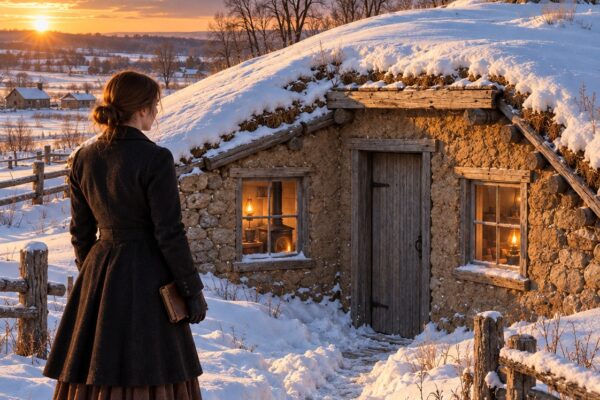
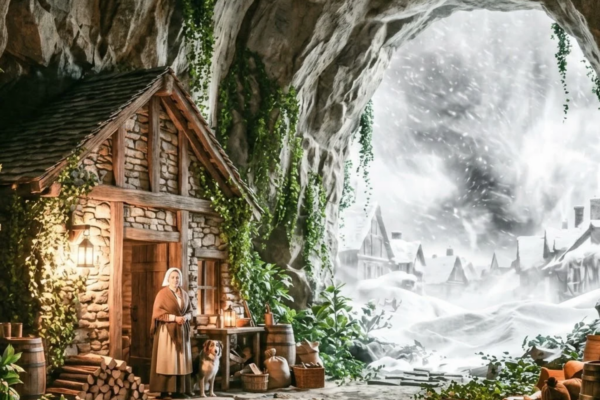
THE FIRE INSIDE THE STONE
Chapter 1 The Last Team in Mercy Creek
On the nineteenth morning after Thomas was buried, Mary Ann Shaw counted her money on the kitchen table while her sons pretended to be horses beneath it. Silas whinnied. Jonah, who had always preferred the useful part of a game, dragged a wooden spoon through the dust and called it a plow.
There were eleven dollars and forty cents. The mortgage notice beside the coins required considerably more.
Mary Ann covered the notice with her hand. She was twenty-nine, and already people addressed her in the patient voices reserved for the very old. They had brought casseroles during the first week. During the second, they had begun offering advice about leaving.
Thomas’s coat hung beside the door. She had searched its pockets three times before finding the map inside a slit in the lining. On the back, in his narrow handwriting, were the words North face. Red wall. Before the frost.
He had said those last three words when speech had begun to hurt him. She had believed he meant the potatoes.
Now frost silvered the inside of the kitchen window.
She dressed the twins in both their shirts, then went into Mercy Creek with the map folded against her breast. At Amos Pike’s mercantile, the stove was surrounded by men who had managed to get there with teams they claimed they could not spare.
“Four days,” she told Amos. “I can pay for the wagon and feed. I need the horses lent.”
He examined the map without touching its middle, as if foolishness might rub off.
“Thomas was a good carpenter,” he said. “That doesn’t make him a surveyor.”
“He wasn’t drawing a county line. He was showing me a place.”
Beside the stove, someone asked whether the place contained a husband who could pay her debts. Another man laughed once and then studied his boots.
Amos offered three dollars for Thomas’s plane and chisels.
Mary Ann rolled the map. “They’re worth eight.”
“To a carpenter.”
She took the tools home.
At noon she dismantled the washstand Thomas had made when they married. She used its curved oak supports as runners and fastened a packing crate above them. The work was clumsy. Thomas would have eased each joint until it settled without protest; she hammered until the boards obeyed. By dark, there was a sledge.
She packed blankets, a kettle, bread, matches in a corked bottle, and the hatchet. She put the eleven dollars inside a stocking and left the mortgage notice on the table.
Before dawn, she pulled the boys north.
At first the road made the undertaking seem reasonable. Jonah waved at their own chimney as though it belonged to a neighbor. Silas asked whether his father would be at the new house.
“No, sweetheart.”
“Then how does he know the way?”
She had no answer that a three-year-old could use.
By the time the road narrowed into a logging track, snow was falling sideways. Mary Ann looped the rope around her waist beneath Thomas’s coat. The sledge scraped and caught. She learned to lean before stepping, to make her whole body part of the pull.
At a creek crossing, one runner broke through the skin of ice. She hauled it free before the blankets touched water, but her right boot filled. An hour later, she could no longer feel the small toes of that foot.
She should turn back. She repeated the words until they lost their meaning. Behind her lay a cold farmhouse they would soon be ordered to leave. Ahead lay a mark made by a man who had never sent her anywhere carelessly.
At the pines, she divided the bread. Silas asked for water. Jonah held the cup but said nothing. She melted snow against her body inside the bottle, furious at how little warmth a person possessed when someone else needed it.
The sledge snagged. She pulled, slipped, and drove her knee against buried stone.
For a while she knelt. Snow gathered on her sleeves. Silas began to cry, and the sound reached her as a command.
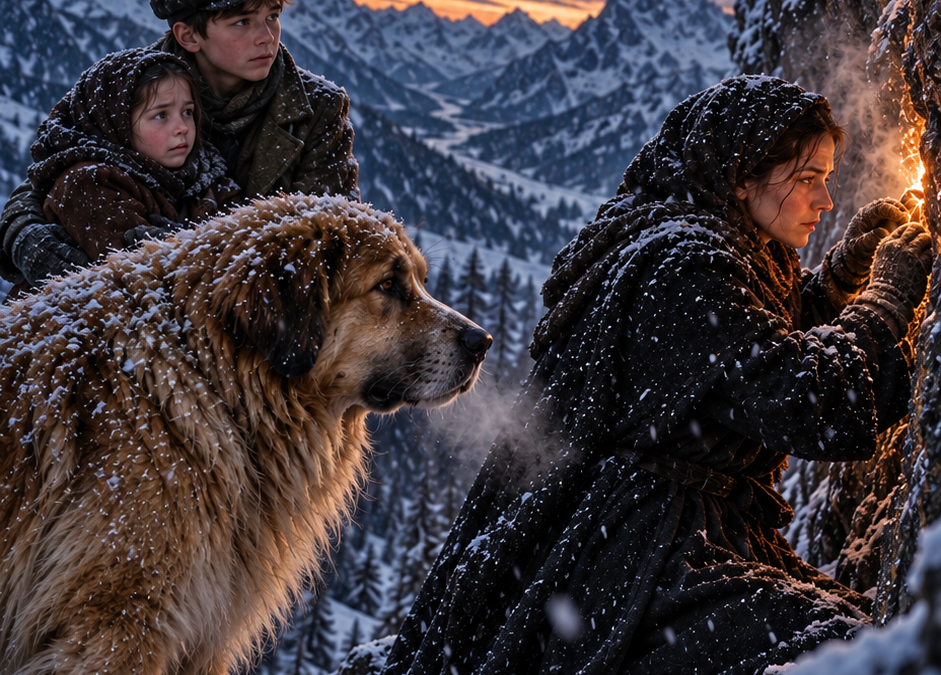
When she stood, a gray dog was watching from the trees.
She recognized the ragged left ear. Thomas had sometimes brought him home, feeding him scraps outside because he would never enter the kitchen.
“Where did you come from?”
The dog turned, waited, and turned again.
She followed him into a cleft between rocks. The wind dropped. Ahead, the red cliff rose through the whitening air, and the cross on Thomas’s map finally had a place in the world.
But the wall was seamless, and Jonah had closed his eyes.
Chapter 2 A Room Kept Warm
Mary Ann lifted Jonah from the sledge and rubbed his back through the blankets. His eyelids moved when she spoke. She held him upright until he complained, a thin irritated sound so welcome that she nearly laughed.
“Stay cross with me,” she told him. “You may be as cross as you like.”
She settled him beside Silas and searched the cliff.
At the base, a shelf of rock caught the blowing snow. She cleared it with her sleeves. Her gloves had stiffened, so she pulled them off and worked barehanded. A seam ran upward for a few inches, disappeared beneath frost, then returned at the height of her shoulder.
The dog pushed his nose beneath the shelf.
Her fingers found a cord.
The first pull produced a wooden knock. The second made a narrow section of the wall give inward. Painted boards, she realized. Red grit embedded in paint. Someone had built a door so carefully that even hope had almost missed it.
Warm air touched her wrists.
She shouldered through, dragged the sledge behind her, and found herself on floorboards beside a stove. A kettle breathed on its iron top. Firewood filled an alcove. There were shelves of jars, a table, two small beds, and a larger bed screened by a curtain.
On the children’s beds lay the quilts Thomas had claimed were ruined by mice.
For a moment, the lie wounded her more sharply than the kindness relieved her. He had watched her mourn those quilts. Her mother had pieced them before her hands grew crooked.
Then a chair scraped in the darkness.
Mary Ann drew the hatchet from her pocket.
An elderly man emerged carrying a lantern. He had a silver beard and a straight back spoiled by the careful way he placed his left leg. The dog went to him immediately.
“Set the children by the stove,” he said.
“Your name first.”
He stopped. “Elias Venn. The dog’s Flint.”
“How do you know we’re children and their mother?”
His eyes moved to Thomas’s coat. “Because I’ve been listening for you for nineteen days.”
She kept the hatchet in her hand while he moved away from the stove. Then she brought the boys to the heat, removed their wet things, and wrapped them in dry quilts. Elias set down broth and returned to the far side of the table.
Jonah spilled his first mouthful. Mary Ann steadied the cup and made herself breathe slowly.
“Thomas found me under a fall of stone in August,” Elias said. “Brought me back here. We had spoken only twice before that. He could have left me. Most would have.”
“He wouldn’t.”
“No.”
Over the following weeks, Thomas had brought medicine, flour, lamp oil. Elias had money hidden away and a ruined leg; Thomas had strength he was running out of, and a family he feared to leave.
“I offered him payment. He asked for the rooms instead. Enough stores to see you through. A place nobody could put you out of.”
“He knew he was dying?”
Elias looked toward the stove. “He knew he might.”
Mary Ann remembered every evening she had scolded Thomas for coming home tired. Every time he had answered that one more job needed finishing.
“He should have told me.”
“Yes,” Elias said.
The agreement steadied her more than any defense of her husband would have.
Under a folded quilt she found a letter. The first line explained the wood. The next described the flour barrels, the spring at the back of the cavern, the stove flue that needed checking after heavy snow. His ordinary practical instructions undid her. He had written as though she might call through the wall and ask where he kept the matches.
Elias placed a canvas packet beside her.
“The deed and the stores inventory. Thomas paid me a dollar, so the paper records a sale. I signed before witnesses.”
“Then stay until morning.”
He had begun putting on his coat.
“I’ve somewhere south to go.”
“In this storm?”
“There’s an old cutting below the pines. Shelter enough.”
She looked at his bad leg. “You kept a fire for my children. You can bear sharing it another night.”
Something tightened in his face. He took the coat off.
When the twins finally slept, Mary Ann read the letter again. Near the bottom, a blot of ink interrupted the instructions.
I meant to bring you here myself.
She laid her palm over the words. Elias turned his chair away while she cried.
Chapter 3 What the Mountain Held
Morning came through a square of pale glass high above the shelves. Mary Ann had mistaken it for another stone during the night. Outside, the storm had buried the door halfway; inside, Silas was counting jars and Jonah was demanding his own spoon.
Their voices sounded almost indecent in the room Thomas had never lived to show them.
She discovered the spring behind a partition of rough boards. Water threaded from the rock into a covered basin and escaped through a stone channel. Beside it stood a copper tub. Farther back, an old passage ended at a wall of fitted timber.
“Mine workings,” Elias said from behind her. “Closed long before I made the living rooms. Leave the boards alone.”
“What did you mine?”
“Copper, mostly. Less of it than my partners wanted.”
He did not offer the partners’ names.
She washed the boys at the basin, then inspected their feet, their fingers, every place the cold might have left a mark. Jonah disliked having his toes counted. Silas asked if the mountain had a kitchen outside too.
“Only this one.”
“Then Father built it small.”
She turned toward the shelves until she could speak again.
While the children played with wooden wedges near the bed, she opened the packet. The deed named Elias as seller and Thomas and Mary Ann Shaw as purchasers. It described a small parcel including the red bluff, the spring, and a strip down to the abandoned hauling road. The signature space for the public recording office was blank.
“He never filed it,” she said.
Elias lowered his cup.
“He was going on the Monday.”
Thomas had died on Sunday.
Mary Ann spread the paper flat. “You told him nobody could put us out.”
“I own it. I sold it.”
“That’s what the two of you agreed. What will the town agree?”
The old man rubbed a thumb over the scar at the base of his left hand. At sixty-two, he had learned how to become motionless when he disliked a question.
“Hale has wanted the spring for years.”
Gideon Hale held their farm mortgage. His office stood above the freight depot, its windows looking down upon everything that entered Mercy Creek.
“Why?”
“He means to build an ore mill below the ridge. Water makes a poor claim profitable.”
She examined the inventory. Three winters was Elias’s generous description, assuming one adult and two small appetites. Two winters, perhaps, if Elias stayed; less if rats got into the flour. The lamp oil needed watching. The wood had been stacked with gaps for air, and the rows nearest the wall were still green.
Thomas had built a possibility. Grief had briefly made her mistake it for certainty.
She found his plane beneath the table, the twin of the one Amos had tried to buy. Alongside it lay a pair of little chairs. One had been sanded; the other still carried the marks of the blade.
Elias watched her lift it.
“He worked there when the coughing got bad. Said sitting idle made it worse.”
“Everything made it worse.”
“Yes.”
She set the unfinished chair down carefully.
By noon the sky had cleared. Elias proposed taking the deed into town himself. Mary Ann refused. His name was on the sale, but hers was on the life that depended upon it.
“I need you here with them.”
“You barely know me.”
“I know you stayed.”
He looked at the twins, who were trying to persuade Flint to sit in the small finished chair. “He called the quiet one Jonah?”
“He isn’t quiet when he’s warm.”
Jonah shouted that the dog required a hat.
Mary Ann laughed before she could stop herself. The sound startled all of them, including Flint.
She packed a cloth bag with the deed, Thomas’s letter, and the mortgage notice she had brought after all, folded so tightly in her pocket that she had forgotten it. She left Elias the money for emergencies, keeping only enough for a meal.
At the door, he caught her sleeve.
“If Hale offers to make this easy, ask what he gets.”
“What happened between you?”
Outside, snow slipped from a pine branch and fell soundlessly.
“I signed something once,” Elias said. “Then spent twenty years pretending I hadn’t.”
Mary Ann put the packet inside her coat and began the descent.
Chapter 4 A Name in the Book
The way down took less than half the time. Without the sledge, Mary Ann could step over the roots that had nearly defeated her. That seemed an accusation until she remembered the weight she had brought safely through.
Mercy Creek was opening its shutters when she arrived. At the mercantile, Amos looked from her face to the empty road behind her.
“The children?”
“Warm.”
He seemed unable to find a suitable next question.
She bought a pencil and passed through to the room behind the store where county records were kept two days each week. Ruth Bell sat at a desk beneath a shelf of bound volumes. Her black hair was pinned so tightly that her eyebrows appeared permanently skeptical.
“Mrs. Shaw. I was sorry about Thomas.”
“I need to record a sale.”
Ruth took the deed, adjusted her spectacles, and read without interruption. Mary Ann loved her a little for that silence.
“The witnesses are Hester Cole and Nathan Reed,” Ruth said. “I know Hester’s hand. Reed surveys for the freight company when there’s work. Was payment made?”
“Elias says so.”
“And Thomas accepted delivery?”
“He stocked the rooms and left me the papers.”
Ruth drew a clean sheet toward her. “We can enter the instrument today. That preserves a record of what you brought and when. It does not settle every possible dispute.”
“What dispute?”
Ruth hesitated over the description. “Hale lodged a notice last spring concerning the lower watercourse. His copy of an old company agreement includes Venn’s signature. Yours describes the spring itself. Those may overlap.”
Mary Ann felt the room shrink around the desk.
“Does he own it?”
“A notice of a claim is a claim. It isn’t proof that the claim is sound.”
Ruth entered the deed, took the fee, and gave Mary Ann a certified copy of the day’s entry. Her movements remained brisk, but when she returned the original, she put it directly into Mary Ann’s hand.
“Keep both dry.”
Hale was waiting outside.
He wore a dark coat with a velvet collar and carried no visible weapon. He had never required one to make Mary Ann afraid.
“Amos tells me you’ve found somewhere to stay.”
“Amos has been busy.”
“I’m glad. Your farmhouse will be empty soon. We can avoid an unpleasant inventory if you surrender the key voluntarily.”
She had expected pain when she heard that. Instead, she remembered the last winter rain leaking through the bedroom roof and Thomas moving a basin in his sleep.
“Send the inventory in writing.”
His expression altered by a fraction.
“I can offer a better arrangement. A cottage near the depot. Work taking in laundry. The boys would have neighbors. All I require is a quitclaim to whatever Venn has persuaded you to think he sold.”
“Why would you require something worthless?”
“Because confusion costs money.”
“Then I won’t add to yours.”
He let her pass, but his voice followed.
“Stone rooms can be dangerous in winter. A blocked chimney. A fall from above. Think about whether grief is making your decisions.”
She did not answer. The remark was plausible enough to trouble her and cruel enough to make her hate him for choosing it.
Hester Cole caught her at the edge of town. The midwife had delivered both boys and had never allowed Mary Ann to pretend a pain was smaller than it was.
“Ruth sent word through the back window,” Hester said. “She thought you’d be stubborn about asking me for help.”
“She has known me ten minutes.”
“Enough, apparently.”
Hester confirmed that she had witnessed the sale. Thomas had stood at her table, coughing into a cloth, while Elias held the pen as though signing away a punishment.
“I asked whether you knew,” she said. “Thomas said he was bringing you after the harvest. I told him surprises were for birthdays.”
Mary Ann looked toward the ridge.
“Will you write down what you saw?”
“Already have.”
Hester passed her a folded statement, then a packet of dried apples.
“For the boys. The paper is for you.”
On the mountain road, Mary Ann stopped to put the statement beside the deed. For the first time since the funeral, her coat held something another person had given her without asking her to leave.
Chapter 5 The First Winter Rule
Elias had made supper. The beans were burned, the bread was hard, and both boys claimed to have helped. Mary Ann ate everything put before her.
Afterward she told Elias about the recording office and Hale’s offer. He listened with his hands clasped between his knees.
“I told Thomas the spring was clear,” he said.
“Was it?”
“The mill company dissolved. Its equipment sold. There was no company left to take water.”
“Hale says there is an agreement.”
“There was. For the old lower channel. A fixed amount in the working season, and payment every year. Twenty years without payment isn’t ownership.”
“Do you have your copy?”
He did not answer quickly enough.
Mary Ann set down her spoon. “We need a rule. No protecting me with missing pieces. Thomas has used up our allowance for that.”
Elias nodded once.
He had come west at thirty-eight with a wife named Clara and enough ambition to mistake work for love. The original mill partnership had promised a steady market for his ore. Instead, it had demanded longer hours, narrower supports, savings made in places nobody could see.
One spring, a timbered passage collapsed. Two men died. Clara, who kept the cookhouse, helped carry out the injured. She survived three days after the smoke and dust damaged her lungs.
“Hale was the junior partner then. His father supplied the money. I signed the inspection sheet the week before. I knew the supports should be replaced. I thought another fortnight would do.”
The old workings behind their partition seemed suddenly closer.
“Are these rooms safe?”
“They were cut in sound rock beside the workings. Separate. But you shouldn’t take my word alone. Reed inspected them with Thomas before the stove went in. His notes are in the tool chest.”
“And the agreement?”
“Same chest. Beneath the tray.”
Mary Ann made him fetch both. She could listen to remorse after she had something solid beneath it.
The inspection notes showed the living chambers, the sealed workings, the flue, the spring channel, and a narrow old escape passage to a ledge above the hauling road. Elias had used that way before his leg was injured. Thomas had marked it Needs steps, handrail.
“He didn’t finish?”
“He ran out of days.”
She read the sentence twice without looking up.
The water agreement was stiff with age. Mary Ann understood enough of it to see a yearly rental sum and a paragraph making diversion conditional upon upkeep of the lower channel. There was also a separate map. The channel followed the cliff before descending toward the abandoned mill site.
“Where are the payment records?”
“In the mill books, if Hale kept them.”
“Did you ask for the rent?”
“At first. Then I stopped going into town.”
Silas appeared beside the table holding a broken wheel from his toy cart.
“Father mends these.”
Mary Ann took it. “I can try.”
“But he knows.”
The words struck with such simple precision that nobody moved.
Elias opened the tool chest again. “Your mother knows how to find out. That’s more useful than you’d think.”
Together they fitted a sliver of wood into the axle hole. Silas tested the cart across the floor and accepted the repair without ceremony.
Later, Mary Ann examined the flue drawing. Hale’s warning had found the one fear she could not dismiss: her children sleeping in a room she did not yet understand.
She and Elias checked the stove joints, cleared the outside vent, and tested the draw before adding wood. She put the tools where she could reach them in darkness. Then she counted the steps from each bed to the door.
“You can go south when the weather settles,” she told Elias. “You don’t owe us your life.”
“I know.”
“But if you stay, you answer questions. Even ugly ones.”
He looked toward the little cart beside Silas’s pillow.
“I’d like to stay until the steps are finished.”
That night she wrote three headings in a spare account book: Food, Repairs, Papers. Beneath Repairs she added the escape passage. Beneath Papers, she wrote Find Nathan Reed.
She left the rest of the page blank for the things Thomas had not been able to foresee.
Before closing the book, she touched the first empty line with her pencil. There was room for more than expenses there. One day, she hoped, she would have something to enter that was wanted rather than necessary.
Chapter 6 Water Under Ice
For eleven days, the mountain allowed them a life.
Mary Ann learned how long flour lasted when measured instead of guessed. She hung wet mittens where the stove warmed them without scorching the wool. Elias carved steps for the escape passage while seated, leaving the fitting to her. The boys named every knot in the wooden partition and quarreled over which one resembled Flint.
At night, when they slept, she sanded the unfinished chair.
She had been angry with Thomas for keeping the refuge secret. She remained angry. But the work let her put her hands where his had been without pretending she understood every choice he had made.
On the twelfth morning, the basin overflowed.
Water crept beneath the partition and darkened a flour sack before she saw it. Elias checked the outlet, then took his coat from its peg.
“Ice at the outside channel.”
They moved the food to the table and raised the bedding. Mary Ann followed him outside with the shovel. The boys watched from just inside the doorway, forbidden to cross the threshold.
Below the cliff, the spring’s outflow should have run through a shallow stone trough. Instead, its mouth was packed with brush and rocks beneath a skin of ice.
Elias crouched painfully.
“Snow doesn’t stack branches crosswise.”
Mary Ann looked beyond him. Tracks cut across the clearing and disappeared into the hauling road. A horse had stood beneath a pine, leaving a stained hollow in the snow.
“Don’t move anything yet.”
She returned for her account book and drew the blocked outlet. She marked where the tracks approached and where they left. Then she helped Elias clear it. Water surged through, carrying dead needles and a smell of old leaves.
Her anger arrived afterward, while she was wringing water from a sack that held a week’s flour.
Somebody had climbed the mountain to make her children cold.
Elias sat with his wet boot beside the stove. “We should have watched.”
“We were sleeping. People are allowed to sleep.”
She said it too loudly. Jonah began crying, and she put down the sack at once.
“I’m angry at the water,” she told him, then corrected herself. “At what someone did to it. You haven’t done anything.”
That afternoon she carried her drawing to Mercy Creek. Hester kept the boys while Mary Ann returned to Ruth’s desk. Elias stayed to clean the room and watch the outlet.
Ruth copied the account into a dated statement.
“Can you identify who placed the brush?”
“No.”
“Then we put down what you saw. Only that.”
It frustrated Mary Ann to write so little when she believed so much. But Ruth’s restraint gave the page a weight an accusation would not have had.
On her way out she saw Amos carrying a barrel into the store. A new spade leaned beside the door, mud still clinging to the blade.
“Who rode north yesterday?” she asked.
“Half the town has business north.”
“At my water outlet?”
He stopped rolling the barrel.
“Hale’s men were looking over the mill route. That doesn’t mean they touched anything.”
“Did you lend them tools?”
“A spade. They returned it.”
“Write down when.”
“I won’t be dragged into a quarrel.”
Mary Ann looked at his clean stove pipe and his full woodbox.
“Someone already dragged me into one. I was at home.”
She left him standing over the barrel.
Hester insisted they eat before climbing back. Silas fell asleep against her apron while Jonah solemnly fed Flint pieces of boiled turnip. The dog declined each piece and accepted it again when offered.
“You could stay here tonight,” Hester said.
Mary Ann wanted to agree so badly that she had to sit down.
“If I go only when I’m afraid, they’ll learn how to move me.”
“And if you never rest, they’ll have no work left to do.”
Mary Ann stayed. In the morning she returned with dry sacks, two borrowed blankets, and Hester’s promise to visit. Beside the outlet she found Elias installing a removable grate.
Above it, he had fixed a bell on a cord that ran into the room.
“If the water rises,” he said, “we’ll hear.”
Mary Ann tested the cord once. Its small bright sound reached both beds.
Chapter 7 The Price of Remaining
The summons arrived with a sack of oats.
Amos had hired a driver to bring supplies to the hauling road, then sent the man up on foot with a folded envelope. Mary Ann accepted it beside the door while Flint inspected his boots.
Inside was notice of a hearing in January concerning access, water use, and an alleged company interest in the red bluff parcel. Hale sought an order preventing any changes to the watercourse until the claims were examined.
He had also enclosed a private offer.
Eighty dollars, the depot cottage for six months, and cancellation of any deficiency remaining after the farm sale. In return, she would surrender the mountain deed and all associated rights.
Eighty dollars was more money than she had ever held at once.
She spread the pages on the table after supper. Elias read them, then turned the private letter facedown.
“You must choose for the boys.”
“That’s what everyone says when they want me to choose what suits them.”
“I mean you needn’t stay to defend my pride.”
She softened. “Then tell me what this place costs to keep. All of it.”
They worked through the inventory. Nails, lamp oil, stove pipe, flour lost to damp. A team would still be needed to carry heavy supplies before the next winter. The steps needed completing. Roof rock above the door required inspection each thaw.
The mountain was cheap only if her labor counted for nothing.
She understood why the cottage tempted her. A pump in a yard. Other children close by. A door anyone could find.
But the cottage belonged to Hale, the laundry work would depend upon Hale’s tenants, and six months would end precisely when she began to believe she was safe.
“I want to stay,” she said. “I need that to be different from having nowhere else.”
Elias considered the distinction. “Then we need an income.”
Thomas had left a workbench and tools. Mary Ann could mend, though slowly. Elias could make stool seats, pegs, handles. Hester had already complained that half the town’s chairs were waiting for the dead carpenter.
Mary Ann wrote a short notice offering furniture repairs delivered to Hester’s back porch. She set prices with care, refusing to call her first month’s labor a favor.
When she took it to town, Amos declined to display it.
“Hale keeps an account here,” he said.
“So did Thomas.”
Amos looked at the counter.
She pinned the notice to Hester’s fence instead.
The first job was a cradle with a broken rocker. The customer left no name, only a coin and a note requesting delivery before Christmas. Mary Ann carried it up the mountain on her back, embarrassed by how much she wanted to do the job well.
That evening, Silas watched her smooth the replacement curve.
“A baby goes there?”
“Yes.”
“Will its father come back?”
She put down the plane. Jonah stopped lining up wood shavings.
“I don’t know about that baby’s father. Yours can’t come back.”
“Even if he finds us?”
“He doesn’t have to find us. He knew where we’d go.”
Silas considered this and began to cry with an anger she recognized. She held both boys on the floor until their knees stopped knocking against her ribs.
After they slept, she took Thomas’s letter from its tin. For the first time, she read the final lines without skipping ahead to the instructions.
If you hate the mountain, leave it. A roof is meant to shelter a life, Mary, not decide one.
She had been treating his gift as another promise she must keep. Now she let herself set it down, look at it, and choose it again.
The next morning, she rejected Hale’s offer in two sentences. She sent the letter through Ruth so its receipt would be recorded.
Ruth read it and asked whether she wanted a copy. Mary Ann did. Having her own words returned to her, dated and legible, gave her an unexpected pleasure. So much of the past month had consisted of receiving other people’s decisions. This small sheet recorded a decision she had made herself, after looking at the cost.
Then she finished the cradle rocker. When she placed it on the floor, it moved evenly beneath the lightest touch, continuing long after her hand was gone.
Chapter 8 The Door in the Storm
Christmas passed with a wooden horse for each boy and dried apples simmered until they became something like sweetness. Elias made a third horse for the unknown baby whose cradle Mary Ann had repaired. She did not ask why he needed the extra work.
On the last afternoon of the year, Hester came up with Nathan Reed.
The surveyor was forty-one, broad through the shoulders, with a face browned by years of working beneath a hat. He carried his instruments in a leather case and looked at every wall before speaking about it.
“Thomas wanted another look after the first freeze,” he said. “I’m late.”
“Everyone keeps telling me that,” Mary Ann answered.
He accepted the rebuke. “Then I’ll start now.”
While Hester checked Elias’s leg and listened to the boys invent rival accounts of the journey, Nathan inspected the chambers and the escape passage. He found no new movement in the living rock. Above the outer door, however, thaw had loosened a slab. He marked a place beyond its reach where a small timber canopy could be built.
“The flue outlet needs raising before another heavy fall,” he said. “Thomas planned for ordinary snow. This year’s settling deeper.”
Elias wrote down the measurements.
Nathan also examined the water agreement. The map brought a frown.
“Hale showed me a different boundary last summer. Farther up.”
“Did you survey it for him?” Mary Ann asked.
“I walked it. Didn’t certify it. His starting point wasn’t the old marker.”
Before he could explain, Flint began barking at the door.
The storm had arrived without the usual long darkening. Snow filled the clearing so thickly that the pines seemed to have moved away. Hester’s mare stamped beneath the rock overhang where they had tethered her.
Then came a voice.
Nathan opened the door. Amos Pike stumbled inside with blood on his sleeve and a boy hanging against his shoulder. A freight wagon had overturned at the bend below. The driver lay trapped, and Amos’s fourteen-year-old nephew had struck his head when the team bolted.
For a second, Mary Ann saw the mercantile counter. Two fingers pushing back a map. Men warming their hands while she stood with a life nobody wanted to help her carry.
“Put him on the bed,” she said.
Hester was already moving.
Nathan took the rope from its peg. Elias reached for his coat, but Mary Ann stopped him.
“Your leg won’t hold. Keep the door clear.”
She and Nathan went down together. The wind found every opening in Thomas’s coat. At the bend, the wagon lay tilted against a tree, one shaft broken. Beneath it, the driver answered when Nathan called, though his voice was faint.
They could not lift the wagon. They used a fallen limb to shift enough weight for the man to drag his shoulder free, then pulled him onto a freight tarpaulin. Mary Ann kept hold of the rope while Nathan took the heavier end.
The climb was short. It felt longer than the whole journey with the boys.
Once she fell to her knees. Nathan stopped immediately, giving her time to stand. The simple courtesy nearly broke her.
Inside, Hester had cleaned the nephew’s wound and covered him with one of the familiar quilts. Silas and Jonah watched from the big bed, solemn with the pleasure and fear of strangers in their house.
Amos stood in the middle of the room. He looked at the shelves, the repaired cradle waiting for delivery, the chairs sized for two small boys.
“Thomas made all this?”
Mary Ann loosened the rope from her waist.
“He began it.”
There was nowhere for Amos to put his eyes after that.
The driver needed warmth and rest before anyone could move him. Hester divided the sleeping places. Nathan took the floor beside the door. Elias showed Amos where to bring water and how to keep clear of the outlet bell.
Mary Ann measured beans into the pot for morning. There would be less for the following week. She added another handful anyway, then moved the flour farther from the damp clothes. Opening the door was only the beginning of the work; the rest required the same care as any other day.
At midnight, Silas woke and asked whether the storm could come inside.
Mary Ann looked at the crowded room, at boots steaming and strangers breathing beneath their blankets.
“Only when we open the door,” she told him. “And we decide when.”
Chapter 9 The Man Beside the Stove
Amos washed the cups before dawn.
Mary Ann woke to the faint scrape of pottery and found him standing at the basin. Without his counter between them, he looked older. There was a patch on the elbow of his shirt that he had apparently never meant his customers to see.
“The boy?” she asked.
“Hester says he’ll mend.”
She put fresh wood in the stove. The driver slept under the table, his injured shoulder supported by folded cloth. Nathan snored softly near the door.
Amos dried the last cup twice.
“I lent them the spade,” he said.
“You told me.”
“Hale’s foreman said he was clearing the old channel. When he brought it back, there were pine needles frozen to the blade.”
“Did you see him block the outlet?”
“No.”
“Then don’t tell me you did.”
He looked relieved and ashamed together.
She took out her account book. Amos dictated the date, the time, and the foreman’s explanation. He signed beneath the words. It was less than a confession and more than he had been willing to give her before.
“Why now?” she asked.
His hands settled on the table.
“Because I saw your boys under those quilts and thought about you asking for a team.”
She waited.
“Because I had one.”
The stove clicked. Mary Ann had known, but hearing it plainly altered the shape of the room.
“I can’t make that better for you,” she said.
“I know.”
“You can keep telling the truth when you’re back behind the counter.”
He folded his wet cloth carefully. “There’s something else. I bought the old mill’s office furniture when it shut. Desk, shelves, two boxes of books. Most were ruined. One wasn’t.”
Elias had risen in his chair.
“Which book?”
“Payments and disbursements. I used some empty pages for stock figures. Didn’t know anybody wanted the rest.”
By noon the sky had cleared enough for Nathan to descend and bring back a team. They moved the injured men to Hester’s house, leaving Mary Ann’s floor muddy and the shelves visibly emptier. The gift of shelter had a price in flour, beans, and wood. She wrote it in the book because kindness still needed counting if it was to last.
Two days later Amos returned with the ledger.
The early pages recorded deliveries and wages in a neat hand. Later entries became hurried. Beside Elias’s annual water rent, the columns were blank for three consecutive years before the mill closed.
Farther back, Elias found the report of the fatal collapse.
He sat very still.
“This isn’t the sheet I signed.”
Mary Ann moved the lamp closer.
The bound copy described the supports as recently replaced. Elias remembered writing that replacements were required. Beneath the copied report was a payment to the timber supplier, followed six weeks later by a credit for an order canceled.
Nathan, who had come to retrieve his rope, read the figures twice.
“It doesn’t prove who changed a report,” he said. “It proves someone paid for timber and then took the money back.”
“Can you find the old supplier?”
“The business is gone. The freight invoices may still exist at the depot. Copies went both ways.”
Mary Ann closed the ledger. “Then we ask for copies before Hale learns what we’re asking.”
Elias put his hand on the cover.
“I won’t say I was innocent. I saw those supports. I let men work beneath them.”
“Nobody’s asking you to say it.”
“Thomas never knew. Not all of it.”
She thought about the grief he had carried into the mountain, and the danger of letting that grief become an excuse to hide.
“You can tell it now.”
That evening Ruth sent a letter naming the official assigned to hear the dispute: Margaret Vale, a circuit referee appointed to examine several contested company claims in the county. She requested originals, witnesses, and precise descriptions of the land.
Mary Ann placed Amos’s statement beside the letter.
The town was beginning to remember. She would need it to remember accurately.
Before putting away the ledger, she wrapped it in an old apron and placed it high above the spring basin. Elias watched without offering to take charge of it. That mattered. He had spent years guarding the story of what happened here; now he was allowing somebody else to keep the evidence where it could be found.
Chapter 10 The Other Way Out
January began with repairs.
Nathan brought timber paid for by Amos. Mary Ann accepted the wood and recorded it as payment toward the food consumed during the storm. Amos began to object, then read her face and stopped.
Together they built the canopy beyond the loose slab’s reach and raised the flue outlet. Elias fitted the final steps in the escape passage. His work grew slower in the damp weather, but he refused help with the handrail until Mary Ann reminded him of their rule about missing pieces.
“My hands ache,” he admitted.
She took the brace from him. “Show me where.”
The passage opened onto a ledge above the hauling road. From there, a narrow path descended through scrub pine to a sheltered hollow. They laid a rope handline where the slope steepened and stored a wrapped blanket near the upper opening.
Mary Ann practiced the route with both boys in daylight. Silas treated it as an expedition. Jonah disliked the ledge and buried his face in her coat.
“You don’t have to like it,” she told him. “You only have to know where my hand is.”
At the bottom she made them turn and look back. The mountain now had two doors in their minds.
Nathan returned from the depot with freight invoices. There had been an order for support timbers, then a cancellation signed with Gideon Hale’s initials. The dates matched the ledger. Ruth made copies and sent a sealed account to Vale by the next scheduled post.
“He’ll know soon,” Nathan said.
“Then he can bring his own records.”
But Mary Ann slept badly. Every sound in the spring channel became a bootstep. Once, when Flint scratched at the door, she reached for the hatchet before recognizing his impatience.
Hester found her rubbing the same clean cup when she visited.
“Being right doesn’t give you another body,” she said. “This one still needs sleep.”
“When the hearing’s finished.”
“That’s what Thomas said about his jobs.”
Mary Ann put the cup down sharply. Hester let the silence stand until it became useful.
They arranged two nights when Hester would stay, giving Mary Ann an uninterrupted stretch of sleep. It felt like surrender until she woke the first morning and discovered she could think through an entire problem without losing the middle.
The problem was the witnesses.
Hester had seen the deed signed. Nathan had seen the boundary markers. Amos could attest to the spade and the ledger’s custody. Elias alone could explain the agreement and the altered report, but his guilt made him eager to accept any accusation, including those that were not his.
Mary Ann sat beside him with the papers.
“Say what happened. Don’t improve it. Don’t punish yourself by making it worse.”
“There isn’t much room between those.”
“Then stay in the room.”
They worked until he could distinguish what he had seen from what he feared. He had approved continued work despite worn supports. He had written a warning on the sheet. He had not seen Hale alter the copied report. He knew no timber had arrived because he had waited for the wagon himself.
On the morning before the hearing, Hale rode to the clearing alone.
Mary Ann met him outside. Elias remained at the table with the boys, within sight of the open door.
“This has grown beyond a widow’s housing problem,” Hale said.
“It began beyond one. You knew that when you offered the cottage.”
He studied the new canopy, the cleared outlet, the repaired sledge leaning against the wall.
“Venn is unreliable. Ask him about the men who died.”
“I have.”
For the first time, Hale had no immediate answer.
Then he looked past her. “Your husband would have taken a sensible settlement.”
“You don’t get to tell me what Thomas would do. You knew where to find him when he owed you money. You never came when he needed work.”
She closed the door before he could answer.
After his horse had gone, Elias asked what he wanted.
“For me to be frightened enough to sign.”
“Are you?”
She looked at the sleeping bags packed beside the escape steps, ready for any emergency.
“I’m frightened,” she said. “He’ll have to manage with that.”
Chapter 11 The Mountain Gives Way
Rain began after dark.
It tapped against the high window with such an unfamiliar sound that Silas woke and asked who was knocking. Mary Ann listened to water running over snow above them and thought of Nathan’s warning about the slab.
The canopy would protect someone standing at the door. It could not keep the hillside from thawing.
Elias checked the spring channel. The flow was fast but clear. Mary Ann banked the stove modestly, put their coats beside the beds, and left the lamp burning.
Sometime before dawn, Flint growled.
The sound from outside was not a crash at first. It was a series of small knocks, stones striking stones, followed by a scrape so deep she felt it through the floorboards.
Then the door shuddered.
Jonah began screaming. Mary Ann lifted him and reached for Silas. Across the room, Elias held the lamp away from the rocking table.
The noise stopped as abruptly as it had begun.
For three heartbeats, nobody spoke.
“Don’t open it,” Elias said.
A drift of fine dust slipped through the upper seam. Outside, meltwater gurgled where the clearing should have been.
Mary Ann set the boys on the big bed and wrapped them in their outer clothes. Elias examined the stove. Its fire still drew, though more weakly. He closed the air control and left the fuel alone.
“We go through the passage,” Mary Ann said.
“Wait for light.”
“We have light. We have a way.”
They took only what had been packed: blankets, food, matches, the papers in their tin. Mary Ann put Thomas’s letter inside the tin, then strapped it shut. The flour and furniture would have to remain.
Elias reached the first step and stopped. His bad leg buckled when he tried to climb.
Mary Ann felt her mind refuse the sight.
She could carry a child. She could lead another. She could not lift a grown man up a narrow passage while keeping them safe.
“Take them down,” Elias said. “Send Reed.”
“You said no missing pieces. Are the rooms holding?”
He pressed his palm against the wall and listened. “Here, yes. The fall was outside.”
“Then stay away from the front. Keep the lamp. We’ll bring help.”
He nodded, but she saw what it cost him to trust rescue rather than arrange an honorable death.
Flint would not leave him. Mary Ann called twice, then stopped. Elias put a hand on the dog’s head.
“He knows his work.”
At the upper opening, the rain had become sleet. She secured Jonah against her back with the broad carrying cloth Hester had given her when the twins were babies. Silas held her left hand and the rope with his other.
They descended one step at a time.
Halfway down, Silas slipped. His grip tore from hers, but the handline held him against the slope. Mary Ann caught his sleeve and drew him close. He was too frightened to cry.
“Your feet next to mine,” she said.
He obeyed. Behind her, Jonah breathed hotly against her neck.
At the hollow she wrapped them in the cached blanket, then continued toward town by the hauling road. Dawn showed the face of the cliff behind them. A mound of broken rock covered the lower entrance. The canopy had been pushed sideways, its outer beam split like kindling.
The house still existed. She could see its high window.
That made leaving worse.
Hester opened her door before Mary Ann reached it. Somebody had seen them on the road.
“Elias is inside,” Mary Ann said. “Alive. He can’t climb.”
Hester took the children. Nathan was fetched from the depot. Amos brought rope, a narrow hauling board, and two men without being asked twice.
The hearing was to begin at ten. Mary Ann remembered it only when Ruth appeared carrying her papers.
“Go,” Ruth said. “I’ll tell Vale where you are.”
At the upper passage, Nathan tied his rope to the board and examined the steps. Mary Ann heard Flint bark below, then Elias answer.
Her knees weakened so suddenly she had to sit on the wet rock.
Nathan called for another length of rope. She stood, found the coil beneath the blanket, and passed it through the opening. There was still work she could do. Her hands steadied as soon as she gave them something definite to hold.
He was still there. For once, the person she had gone back for was still there.
Chapter 12 What Could Be Carried
They brought Elias out near noon.
Nathan guided the hauling board through the narrow turns while Mary Ann held the lamp below him. Amos and the other men took the weight from above. Elias bore the pain silently until his leg struck a corner; then he swore with such force that Flint barked in agreement.
Mary Ann laughed, a short helpless sound.
“Sorry,” Elias muttered.
“Don’t be polite now. It’s alarming.”
Outside, they wrapped him in blankets and lowered him down the slope. The house remained warm behind them, unreachable by its proper door. Mary Ann went back once for the account book and the two wooden horses. She looked at Thomas’s workbench, considered a third armful, and made herself leave it.
At Hester’s, the boys were eating bread in the kitchen. Jonah climbed into her lap and refused to move. Silas asked where Flint would sleep.
“Beside Elias.”
“Then where will Elias sleep?”
Hester pointed toward her own bed. “In the place with the best mattress. Apparently bad manners earn privileges.”
Elias shut his eyes. His face had gone gray beneath the weathering.
Vale came that afternoon with Ruth. She was a compact woman in her fifties, wearing an ink-stained cuff beneath a traveling coat. She asked after Elias before asking a single question about the land.
“The hearing is adjourned until the day after tomorrow,” she said. “I intend to see the site tomorrow, weather permitting. I won’t hear a dispute about a spring nobody has bothered to show me.”
Mary Ann started to thank her, then asked, “Does the fall change the claim?”
“It changes access. It doesn’t answer who owns the parcel. We’ll keep those questions separate.”
After they left, Hester brought broth to the kitchen table. Mary Ann could not swallow it.
“He built us a home,” she said. “I couldn’t even keep the door clear.”
Hester sat opposite her.
“You brought the children out. Then you brought a man out. What exactly do you think a house is for?”
Mary Ann stared at the bowl. She knew Hester was right and could not yet bear the comfort of it.
That night she slept between the twins on a mattress near the kitchen stove. In a dream, Thomas stood outside the red cliff asking why she had left his tools. She woke furious with him, then understood that the voice had been hers.
Before breakfast, she wrote a list of what remained recoverable. Most of the food. The beds. The tools. The table with one leg shorter than the others, because Thomas had meant to fix that too.
Beside the list she wrote what must change.
The main door could not stand beneath a fall line. The upper route needed a gentler approach. A future storm would not wait until Elias’s leg improved or the twins grew stronger.
Nathan took Vale to the site while Mary Ann showed Ruth the papers at Hester’s table. Amos brought the mill ledger and described where it had been kept. Without anyone requesting it, he included the pages he had used for store stock.
“Don’t tear them out,” Ruth said. “They help show this is the same book.”
At noon, Nathan returned with wet boots and a drawing.
“There’s room for a side entrance from the hauling road. It would use the upper passage without the ledge descent. Work, but possible.”
Mary Ann studied the line. “How much work?”
He gave her an estimate instead of a reassurance. She respected him for it.
She had money from five repairs and one unpaid chair. It would not cover half.
“We could sell some stores,” Elias said from the bedroom.
“We need those.”
“We also need a door.”
She went to sit beside him. “We haven’t even settled whether they’ll let us keep the place.”
“Then tomorrow we do that. Afterward we decide what we can afford.”
His willingness to imagine afterward brought her closer to tears than the rescue had.
Before bed, she unfolded Thomas’s letter. The creases had begun to tear, so she laid it flat between two sheets of clean paper.
She did not ask it for directions. She had enough of her own to begin.
From the mattress by the stove, Silas called her name. He wanted the cup left within reach, exactly where it had stood beside his mountain bed. She carried it over and watched him settle. Even in a borrowed room, they could arrange a few things as they wished.
Chapter 13 The Things Witnessed
The hearing took place in the schoolroom because the records office could not hold everyone who wished to watch.
Mary Ann disliked the audience until she recognized the men who had stood beside Amos’s stove. They had found time to hear what would happen to her. She intended to give them something worth remembering.
Vale sat at the teacher’s desk. Ruth arranged the papers at her right. Hale occupied the front bench with his company’s documents stacked neatly beside him.
The children remained with Hester’s neighbor. Elias sat beside Mary Ann, his cane across his knees.
Vale began with the deed.
Hester described the signing. Nathan identified the parcel from the old markers and his own measurements. Ruth confirmed when Mary Ann had presented the document. Hale did not claim the signatures were false. He argued that Elias had already granted his company interests broad enough to prevent the later sale from conveying unrestricted use.
Vale asked for the original agreement.
Hale produced the same words Elias had kept, accompanied by a newer map.
Nathan rose when called. He showed where the newer drawing began above the historic marker, extending the company’s claimed corridor toward the spring itself.
“Did you certify that map?” Vale asked.
“No. I declined.”
Hale said the marker might have moved.
“It is cut into bedrock,” Nathan replied.
Somebody at the back coughed to disguise a laugh. Vale waited until the room settled.
The rent entries came next. Hale maintained that the company had continued in reduced form after the mill closed. Vale asked for proof of payment and channel maintenance. He had brought neither, describing the absence as an oversight.
Then Amos carried the ledger to the desk.
He explained its purchase and storage. He admitted using its blank pages. He identified the spade loan without pretending he had seen what happened on the mountain.
Hale leaned forward. “A widow feeds you once, and twenty-year-old books become evidence?”
Amos’s face darkened.
“I had the book before she fed me. I had the team before she needed it too. Neither fact improves with hiding.”
Mary Ann kept her eyes on the floor until she was sure her expression would not betray her.
When Elias rose, the room grew quiet in a different way.
He described the worn supports, his warning, and his decision to keep the men working. He named Clara and the two dead workers, names Mary Ann had heard him practice at the kitchen table until he could say them without looking away.
“I should have stopped the work,” he said. “Whatever else is in these books doesn’t excuse that.”
Vale examined the copied report and the canceled timber payment. Nathan submitted the freight invoices. Hale said old business decisions had no bearing on a present water dispute.
“Their bearing is on the reliability of the records you ask me to accept,” Vale answered. “Responsibility for the collapse is a separate matter. I will refer these documents for examination.”
Mary Ann saw Elias’s fingers tighten on his cane. He had wanted truth, but truth still frightened him.
At last she was called.
She spoke about receiving the map, finding the deed, and taking possession. She described the blocked outlet, limiting herself to what she had seen. She gave no account of Hale ordering it, because she had none.
Then Hale asked whether grief had impaired her judgment when she dragged two children into a storm.
The schoolroom went still.
Mary Ann gripped the edge of the bench, feeling again the rope beneath her ribs.
“Yes,” she said. “I made mistakes. I should have carried more water. I should have left earlier. I should have had help.”
Hale opened his mouth, but she had not finished.
“I asked for help. The mistakes I made don’t give your company my spring.”
Vale wrote something on the page before her.
The hearing ended near dusk. She would issue a written determination after reviewing the originals and the survey. Until then, neither party was to alter the disputed watercourse except for necessary protection of the dwelling.
Outside, the sky had cleared to a hard winter blue. Mary Ann helped Elias down the steps. Nobody told her to go east.
That small absence felt almost like a place to stand.
Chapter 14 The Cost of a Door
Vale’s determination arrived four days later.
Mary Ann read it at Hester’s table while Jonah leaned against her knee and asked whether the marks were a story. She told him they might become one if everyone kept quiet long enough.
The recorded sale stood. The evidence did not establish that the old mill agreement conveyed ownership of the spring or the dwelling parcel. Any surviving claim to seasonal use of the lower channel would require a separate showing of performance and scope; it could not be used to displace the Shaws from their home.
The newer map was rejected as a basis for the claimed boundary.
Mary Ann reached the end, then began again.
“Can we go home?” Silas asked.
“We can keep it,” she said. “We still need a safer door.”
Elias asked Ruth to preserve a copy of his sworn testimony with the mill records. Whatever inquiry followed, he would answer it. Mary Ann did not tell him that confession would make him well. His leg still hurt, Clara was still dead, and some consequences had no remedy large enough.
But he no longer spoke of leaving before anyone could ask him to stay.
The farm sale proceeded. There was no miracle in the figures. Their improvements had been valued cheaply, the debt expensively, and most of what remained belonged to creditors. Ruth examined the accounting and challenged two fees. Mary Ann received enough to pay Nathan for the first stage of the new entrance and purchase sound hinges.
She visited the farmhouse once before surrendering the key.
The washstand was gone because she had turned it into the sledge. A pale rectangle on the wall showed where their wedding picture had hung. She had expected Thomas to seem nearer there. Instead, she felt the draft beneath the door and remembered trying to keep the twins warm in that kitchen.
She took a rose cutting from the bush beside the step, though Hester warned it might not survive.
“Neither did we look likely,” Mary Ann said.
Work on the entrance began during a spell of hard clear weather. Nathan opened a short approach from the old hauling road to the upper passage, building steps broad enough for a child beside an adult. The loose face above the original door was left alone until a proper crew could clear it safely.
Amos supplied rope and nails at cost. Two men from the mercantile offered a day’s labor. Mary Ann accepted after setting out the work and the hours, making it plain that she would remember what each had done without turning their help into a debt she could never finish paying.
One of them apologized while carrying boards.
“I thought somebody else would lend you a team.”
She held the door frame steady.
“Next time, ask who.”
He nodded and lifted the other end.
They recovered the stores through the upper passage. Some flour was spoiled, but most jars remained sealed. The beds had not shifted. Thomas’s workbench stood where she had left it, a curl of pale wood still caught beneath its leg.
Mary Ann brought the boys up only after Nathan had tested the new railing. Jonah climbed with his face pressed to her sleeve. At the top, he reached out and touched the door.
“This one has a handle.”
“Yes.”
“Can people see it?”
“If they come looking.”
She had painted it blue. Against the red stone and winter trees, the color was startling. Elias said Thomas would have preferred the disguise.
“Thomas isn’t the one who has to find it in a storm,” she replied.
Elias considered that and nodded.
On their first night back, they ate at the table with both little chairs drawn close. Mary Ann had finished sanding the second one but left a small patch beneath the seat untouched, where Thomas’s tool marks remained.
She did not explain it to the boys. They would discover it later, when they were old enough to turn a chair upside down and wonder about the hands that made it.
Before bed, she opened her account book. Under Repairs she crossed out Entrance. Under Food she noted what had been lost.
On a fresh page she wrote the price of hinges, labor, and paint. Then she added the first payment received for a repaired table.
The columns did not balance yet. They were moving toward each other.
Chapter 15 The Winter After
In April, the rose cutting put out a leaf.
Mary Ann found it in the chipped pot on the window shelf, a small red fold she nearly mistook for damage. She carried it to Elias, who examined it as solemnly as Nathan had examined the cliff.
“It’s alive,” he pronounced.
“I can see that.”
“Then why bring it to me?”
She smiled. “I wanted a witness.”
Spring changed the mountain’s sounds. Water rushed below the hauling road. Birds nested near the old entrance, which Nathan’s crew cleared after the thaw. Mary Ann kept that door for moving stores, but the blue one became the way guests came in.
There were guests often enough now to require a second kettle.
Hester brought mending and news. Ruth came once each month with papers to explain or simply supper to share. Nathan delivered furniture from town when he had room on his wagon. Mary Ann paid for the hauling with repair work and learned to make her joints clean enough that he stopped inspecting them before loading.
The workshop became known for sturdy chairs and careful accounts. Elias made toys when his hands allowed. He refused to put a price on the first horse until Mary Ann made him calculate the hours.
“Thomas would have given it away,” he said.
“Thomas married a woman who can count.”
The inquiry into the old collapse continued. Letters came, and Elias answered them. No page restored Clara or the workers. Some days he withdrew so completely that Mary Ann left food beside his chair and took the boys outside. Other days he told them about a woman who could make bread in a bad oven and never allowed him to call that a small accomplishment.
The twins began carrying his cane when he forgot it. He pretended to resent the service and walked more carefully because of it.
Hale’s mill project stalled without undisputed water rights. His office remained above the depot, and Mary Ann still passed it when she went to town. He was neither ruined nor transformed. She found that she could bear this. His attention no longer determined where her sons would sleep.
Amos kept her repair notice beside the counter. When a new widow came asking about freight work in May, he offered a team before explaining the conditions. Mary Ann heard about it from Hester and made no public speech of forgiveness.
The woman got where she needed to go. That mattered more.
On the first warm Sunday, Mary Ann took the boys to Thomas’s grave. Elias stayed behind to watch a pot of beans, though the beans did not need watching and everyone knew it.
Silas carried a wooden shaving curled like a ribbon. Jonah brought a stone from the spring, polished smooth by water.
They placed both beside the marker.
“Does he know about the blue door?” Silas asked.
Mary Ann knelt in the new grass. “I hope so.”
“Would he like it?”
“He’d say I used too much paint. Then he’d check the hinges.”
Silas accepted this. Jonah pressed his hand against the earth and announced that Father ought to have a horse too.
On the walk home, they talked about making one. The conversation lasted from the cemetery gate to the first rise, turning practical as arguments about size and color began. Mary Ann let them quarrel. The ordinary noise of her children no longer seemed a betrayal of the dead.
That evening she took Thomas’s letter from its protective sheets and placed it in a shallow frame Nathan had helped her make. She hung it beside the workbench, low enough to read without taking it down.
She stood there a long time.
“You should have told me,” she said quietly.
The room offered no answer. She had stopped expecting one.
“But thank you for the chance.”
Outside, Elias called that the beans were ready. Jonah disputed this because he had just tasted one and found it too hot. Silas was trying to put a wooden horse on Flint’s back. The dog endured the attempt with the patient dignity of age.
Mary Ann went to the blue door and opened it. Warm evening air entered, carrying the smell of wet pine and earth released from snow.
From the road below, the house was visible now: a window, a painted door, a thin thread of smoke. A place someone might find without a secret map.
She called the boys in for supper. Then she waited on the threshold while Elias climbed the last steps, his hand steady on the rail she had helped build.
Behind her, the fire needed another piece of wood.
Mary Ann went to get it.